
REVIEW · ROTORUA
Rotorua: ‘Thermal Path Tour’ Geothermal half day Tour
Rotorua’s geothermal sights are not limited to the famous geysers. This four-hour trip takes you to hot lakes, a colored crater lake, active mud pools, and a powerful hot spring, then finishes with a soak at Waikite Valley Thermal Pools. It is a good way to see the strange side of Rotorua without spending a full day on a large coach tour.
I like the small group of no more than eight, which gives guide Stephen, also referred to as Steph or Steve, room to adjust the pace and answer questions. I also like the mix of short walks and drives: you get close to the geothermal features without turning the day into a strenuous hike.
The main drawback is that the Waikite Valley bathing stop can be affected by program changes. One guest reported missing the pools after a late change and receiving only a brief stop at Kerosene Creek instead, so confirm the bathing portion before you set your heart on it. The walks also require steady footing and a reasonable level of fitness.
Key points to know before booking
- Rotorua’s largest hot water lake provides the first look at the forces below the ground.
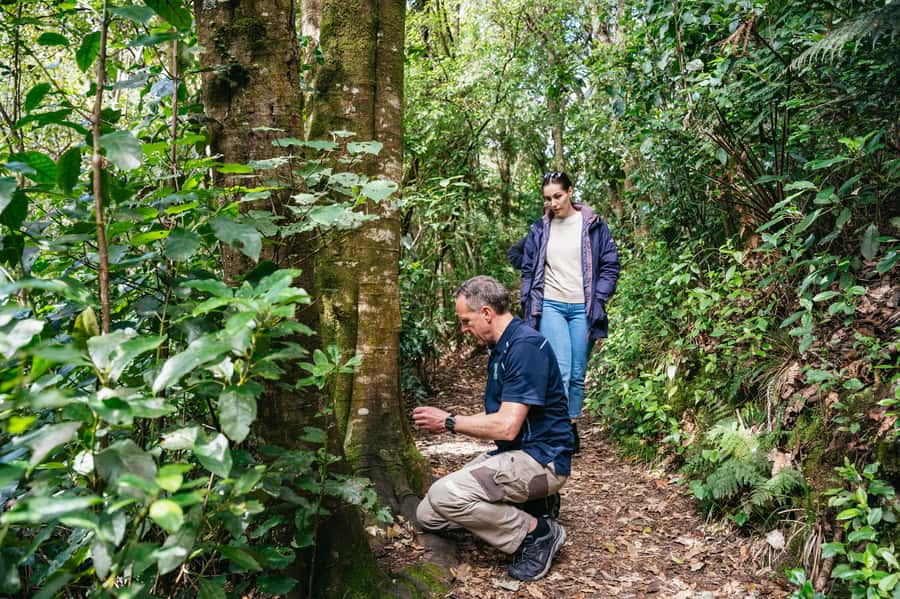
- Rainbow Mountain includes native forest and a colored crater lake, with a walk of up to two kilometers across uneven ground.
- The region’s largest active mud pool bubbles, bursts, and releases steam and gases.
- Te Manaroa Spring sends boiling water from underground, surrounded by plant life adapted to heat.
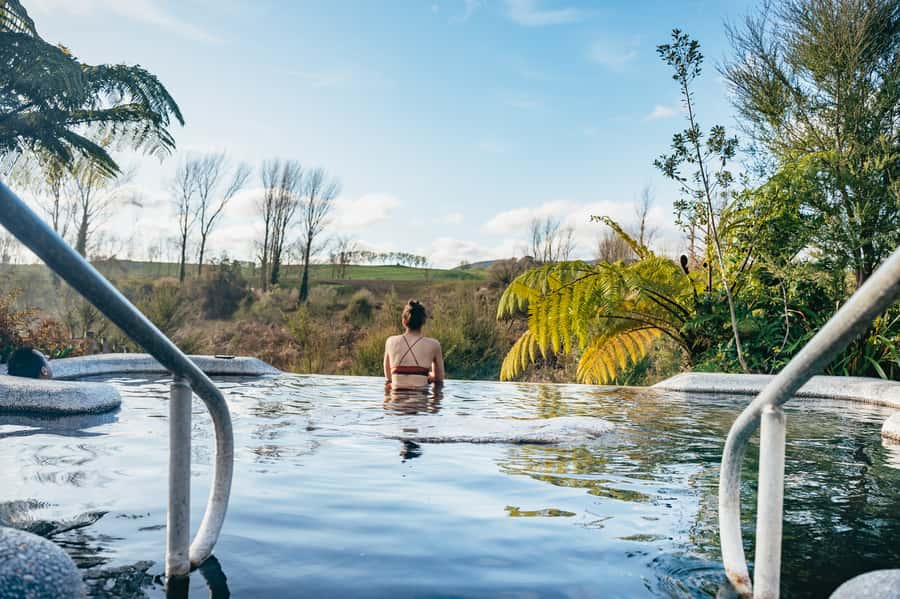
- Waikite Valley Thermal Pools are included, giving you a relaxing finish after the walking stops.
- The small group and local guide matter, especially at places you are unlikely to find on your own.
Why this four-hour Rotorua tour works
Rotorua is one of those places where the ground never feels entirely still. Steam rises from pools, mud pops like a slow cooking pot, and water can be hot enough to boil. The Thermal Path Tour gives you a compact introduction to that world, with less time spent on the road than a full-day outing.
At $89 per person, the price is fair if you want transport, a guide, and entry to Waikite Valley Thermal Pools in one half-day package. You are not simply paying for a ride between attractions. The value comes from reaching several different geothermal settings, learning how they connect, and avoiding the work of finding each site yourself.
You will ride in comfortable air-conditioned transport with a group limited to eight people. That size is useful here. Geothermal sites need careful supervision, and a smaller group makes it easier to hear explanations and keep together on the walking sections.
The tone is relaxed rather than rushed. The route includes several brief stops, a short forest walk, and a final bathing period. You should still allow the full four hours, since the experience is built around moving between distinct areas rather than staying at one major attraction.
More Hot Spring Day Trips in New Zealand
- Rotorua Highlights Inc. Te Puia & Secret Spot Hot Tubs Day Tour
★ 4.5 · 129 reviews - Half-Day Tour – Ex Rotorua: WAI-O-TAPU Thermal Wonderland
★ 4.7 · 101 reviews - Half-Day Tour – Ex Rotorua: WAI-O-TAPU Thermal Wonderland
★ 4.0 · 8 reviews
Starting with Rotorua’s largest hot water lake
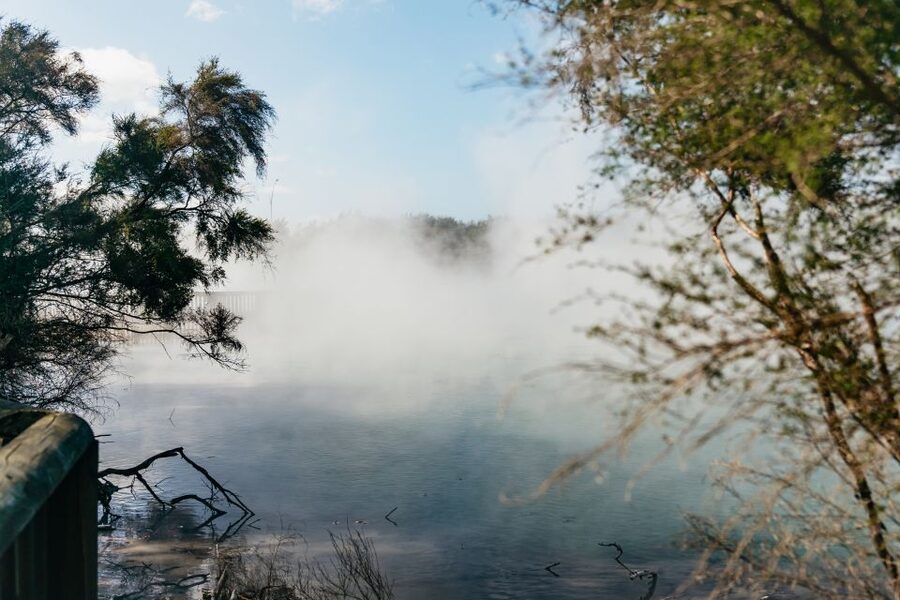
The first stop introduces you to Rotorua’s geothermal character through its largest hot water lake. This is a strong opening because it gives you scale before the tour moves on to smaller, more active features.
A hot lake shows that geothermal energy is not limited to a single vent or spring. Heat rising from underground can affect a broad area, producing warm water and unusual plant growth around the edges. Your guide uses this setting to explain what is happening below and above the surface.
This stop is more about getting your bearings than ticking off a famous landmark. If you want constant action, the lake may feel quiet compared with the later mud pool. I see that as a useful tradeoff. The calm beginning helps you understand the wider geothermal system before you watch water and mud erupt from smaller openings.
Bring closed-toe shoes even if the weather is warm. The tour includes natural paths and uneven surfaces, and sandals are a poor choice for the walking portions.
Walking through Rainbow Mountain’s native forest
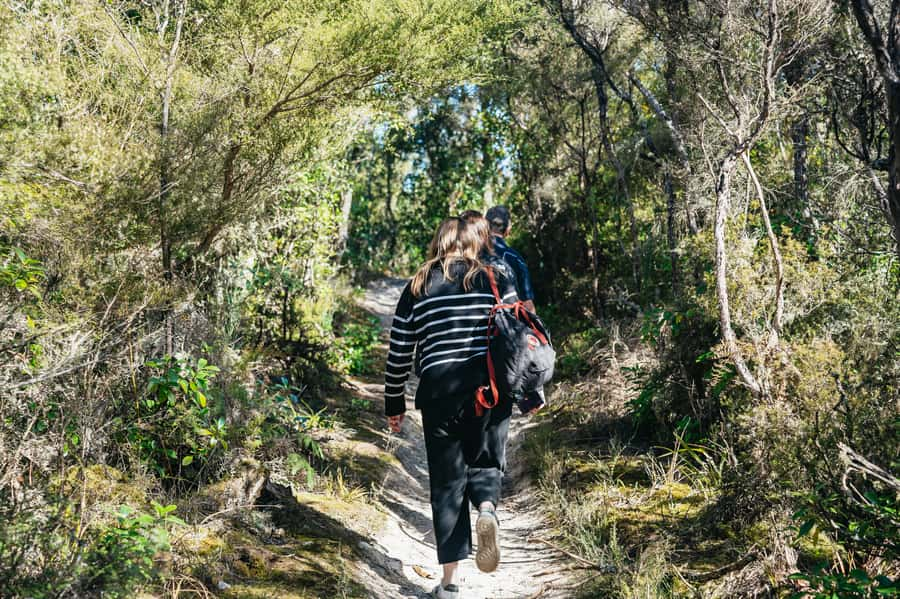
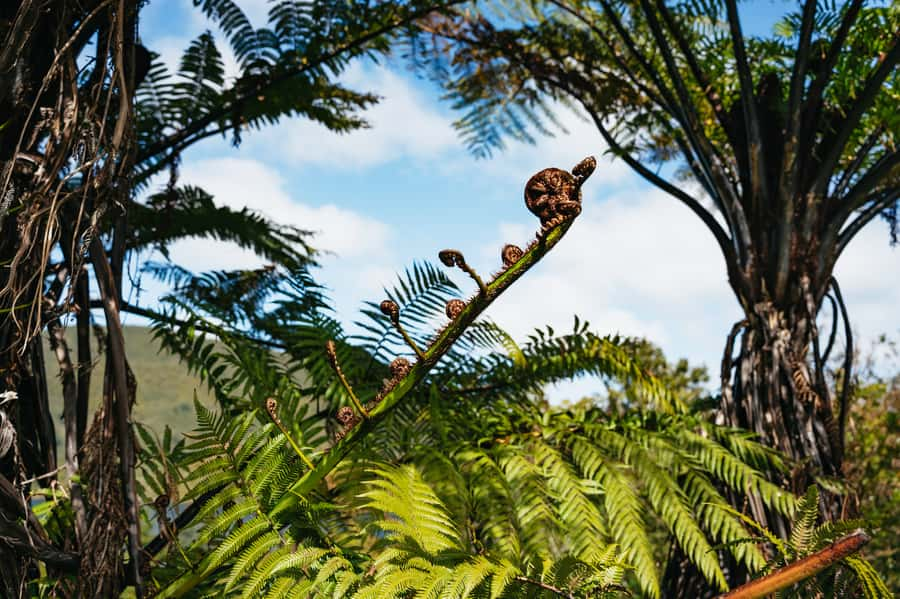
At Rainbow Mountain, you walk through native forest before reaching a colored crater lake. This is one of the more interesting parts of the route because the plants are not just decoration. The heat and mineral-rich ground create conditions for vegetation found in this part of New Zealand.
The walk is described as short, but the full tour can include up to two kilometers on foot. Expect tree roots, rocks, uneven ground, and possibly slippery patches. You need reasonable balance and fitness, though this is not presented as a long hiking excursion.
The crater lake is the visual highlight of this stop. Its color comes from the minerals and geothermal conditions around the crater, giving you a scene quite different from the steaming pools later in the day. I like this contrast. Rotorua’s geothermal character is not only about smoke and bubbling water; it also appears in the color of the earth and water.
Stay on the formed path. In geothermal areas, a thin crust can cover hot fluids or unstable ground. The warning is not just a formal rule. Straying from the trail can expose you to hot water or dangerous gases, including carbon dioxide and sulphide.
Watching the region’s largest active mud pool
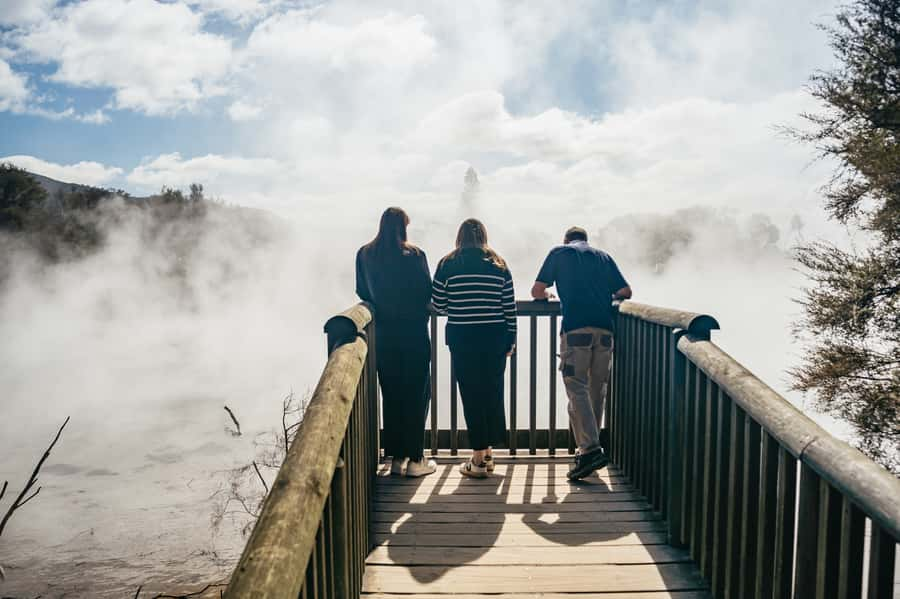
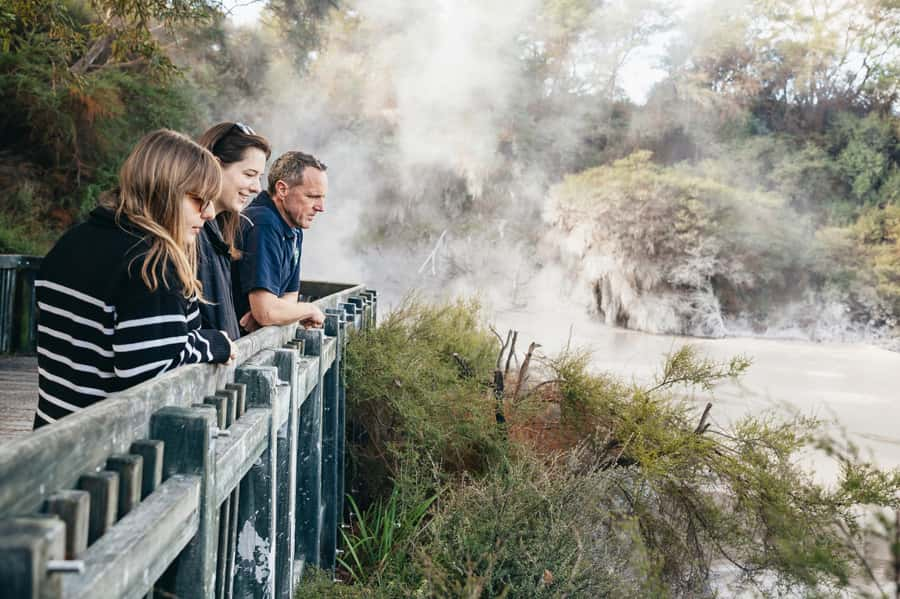
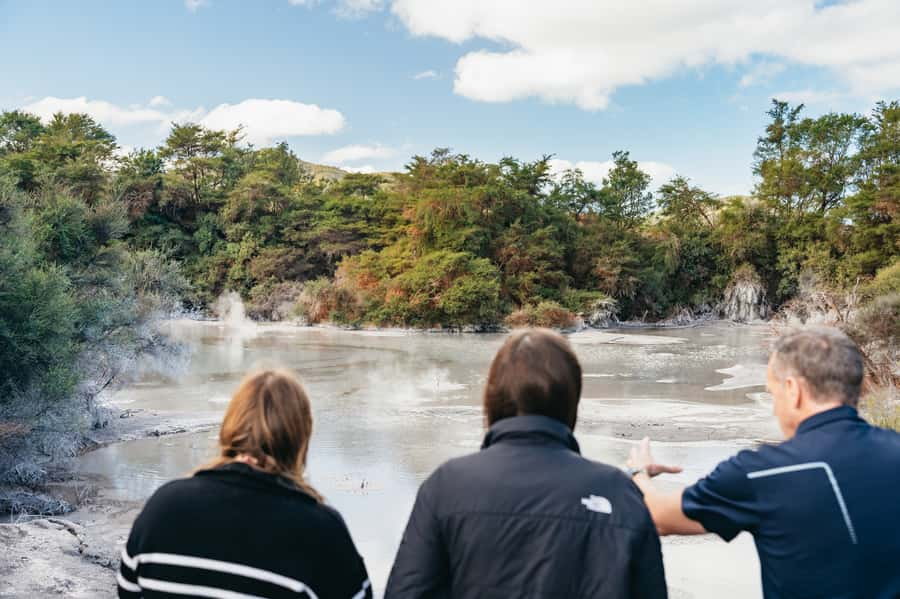
The next stop brings you to a huge mud pool, described as the largest and most active in the region. This is where the tour becomes especially atmospheric. Steam and gases rise through the mud, bubbles swell on the surface, and then each one collapses with a soft burst.
A mud pool behaves differently from a hot spring. Instead of clear water flowing over rocks, you get thick, shifting mud that seems to breathe. The slow rhythm makes it easy to watch for several minutes, and the activity changes constantly enough that you are unlikely to see exactly the same surface twice.
Keep a safe distance and remain on the marked route. Hot mud can cause serious burns, while geothermal gases can be harmful or fatal in concentrated areas. The guide’s role is important here, not only for explanation but also for keeping the group in safe places.
This stop should suit photographers, but conditions can be steamy and visibility may change. I would bring a phone or camera only if you are comfortable using it carefully around wet, slippery paths. Protect your footwear and avoid leaning over railings or natural edges for a closer picture.
More Hot Spring Day Trips in Rotorua:
- WAI-O-TAPU Geothermal, Rotorua – Group Day Tour Ex Auckland
★ 4.3 · 4 reviews - From Rotorua: HELL’s GATE Geothermal MUD BATH Half Day Tour
★ 5.0 · 2 reviews - From Valencia: Full Day Tour to Montanejos & Thermal Pools
★ 4.7 · 2,452 reviews - From Antalya/Kemer: Pamukkale & Hierapolis Day Trip w/Meals
★ 4.5 · 2,196 reviews
Te Manaroa Spring and boiling water from below
A short walk leads to Te Manaroa Spring, Rotorua’s largest hot water spring. Here, boiling water surges from underground, with vegetation growing around the warm area.
The spring gives you a better sense of geothermal pressure. A mud pool bubbles and collapses, while a hot spring can push a steady flow of water upward and outward. Seeing both on the same half-day route helps you understand that Rotorua’s geothermal activity takes several forms.
This is another stop where the setting matters as much as the feature itself. The surrounding plant life softens the scene, but it should not make you forget the danger. Hot water remains hot, even when the area looks peaceful.
The walks at Rainbow Mountain and Te Manaroa Spring are short enough to fit into a half-day outing, but they are not suitable for everyone. The tour is not designed for wheelchair users, people with mobility impairments, or anyone with a low level of fitness. Children under six cannot join.
Ending at Waikite Valley Thermal Pools
The final stop is the most relaxing: entry to Waikite Valley Thermal Pools. After several walks and close looks at boiling water and mud, you can change into swimwear and spend time in silica-rich thermal water.
This finish gives the tour a pleasant shape. You begin by learning how geothermal heat affects a large lake, move through forest and crater country, see mud and boiling water in motion, and then use the heat in a controlled bathing setting. It is a clear contrast between geothermal water as a hazard and geothermal water as a source of comfort.
Bring your swimwear and a towel if you have one, although the supplied information only confirms entry to the pools, not towel provision. Food and drinks are not included, so plan around the four-hour schedule rather than expecting a meal or refreshments as part of the tour.
Take the bathing safety warning seriously. Keep your head above the water at all times because of the risk of amoebic meningitis in geothermal water. You should also follow all pool instructions, even if the water feels calm and comfortable.
The Waikite stop is a major part of the value for many people, but it is the point most worth confirming when you book. A late program change once meant that a guest missed Waikite Valley and had only a short visit to the warm waters of Kerosene Creek. If the soak is your main reason for booking, ask whether Waikite Valley is definitely included on your date.
What the guide adds to the experience
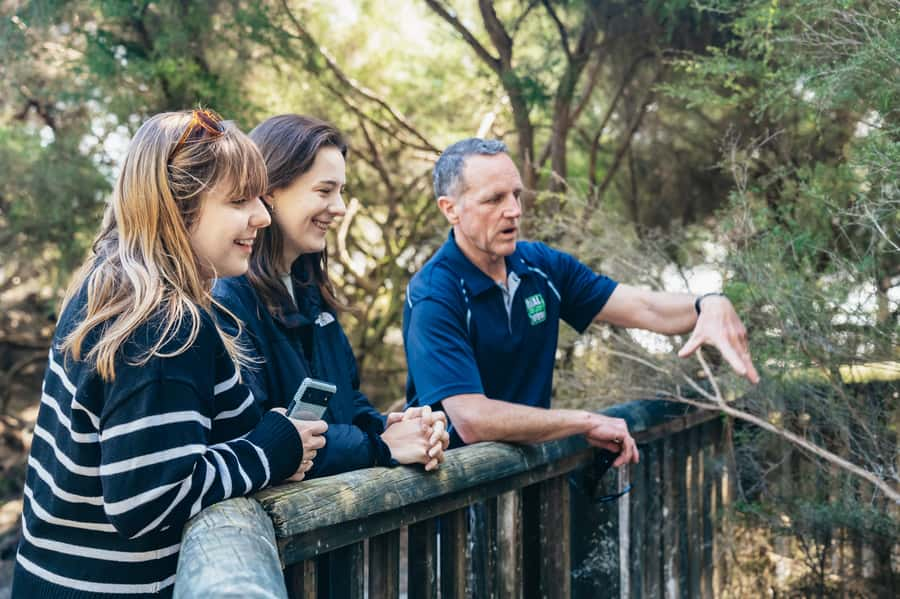
The route includes places you might not locate easily without local help. The guide connects the stops and explains why a hot lake, crater lake, mud pool, and spring behave differently.
Stephen received repeated praise for being friendly, attentive, and well informed. He also continued with the tour when only two people were booked, which suggests that the experience can remain personal even when demand is low. Another guide name appears as Steve or Steph, so check who is leading your departure if knowing the guide matters to you.
The personal approach seems especially useful if you have particular interests. One guest appreciated that the pace and discussion suited the group, while another liked the small personal touches. You should feel comfortable asking questions during the drive and at each stop, rather than waiting for a formal lecture.
The experience is in English. If you want a silent sightseeing trip, the explanations are part of the point. If you like learning how a place works, the guide can turn a series of unusual sights into a connected story.
Practical preparation for the walks and pools
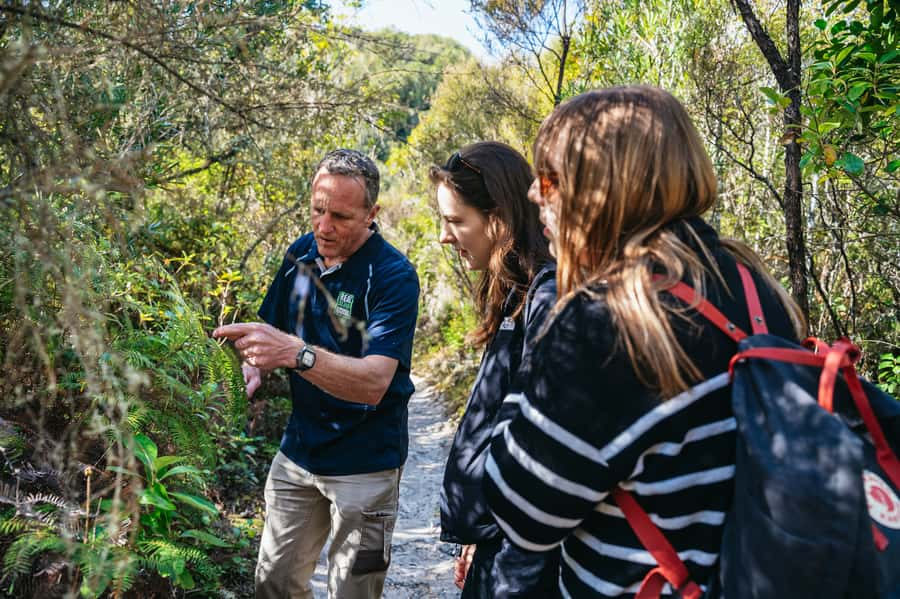
Wear comfortable clothing and closed-toe shoes with a steady grip. The paths may include roots, rocks, uneven surfaces, and slippery ground. The tour can involve up to two kilometers of walking, so it is not a good fit if you struggle with balance or long periods on your feet.
Pack swimwear for Waikite Valley. You may also want a light layer for the vehicle and walking stops, since steam, shade, and changing conditions can make the temperature feel different from one stop to the next.
Stay on formed paths throughout the geothermal areas. Hot fluids may sit below a thin crust, and gases such as carbon dioxide and sulphide can collect near geothermal features. Keep children close, follow the guide, and do not step off the trail for a better photograph.
The tour includes transport, guiding, and Waikite Valley entry. It does not include food or drinks. Cancellation is free up to 24 hours before departure, and you can reserve now and pay later, which helps if your Rotorua plans are still shifting. Starting times vary, so check availability for your date.
Is the $89 price good value?
I think the $89 price is reasonable for a four-hour small-group trip, especially if you value convenience and instruction. You receive air-conditioned transport, a guide, access to several geothermal areas, and entry to the thermal pools.
The calculation changes if you only want a spa session. In that case, paying for the full route may not suit you. The tour is best value when you want both the natural sites and the bath at the end.
It is also good value for a first Rotorua visit when you have limited time. You see several types of geothermal activity without giving up an entire day. The tradeoff is that each stop is part of a moving itinerary, so you will not have unlimited time at any one feature.
Who should book the Thermal Path Tour?
Book this if you want a small, local-feeling trip that reaches less obvious geothermal places and ends with a soak. It suits couples, friends, and independent visitors who prefer a guide but do not want a large group.
It is also a strong match for anyone interested in geology, plants, photography, or the way geothermal heat shapes daily life and the natural environment. The guide-led format gives you more context than simply driving from one viewpoint to another.
Skip it if you have limited mobility, low fitness, or a strong dislike of uneven paths. You should also think twice if Waikite Valley is non-negotiable and you cannot confirm that the bathing stop will operate as planned.
Should you book it?
I would book the Thermal Path Tour if you have four hours, can manage up to two kilometers of uneven walking, and want more than Rotorua’s best-known attractions. The combination of Rainbow Mountain, the active mud pool, Te Manaroa Spring, and Waikite Valley gives you a varied half-day with a satisfying finish.
Before paying, confirm the departure time and that Waikite Valley Thermal Pools remain part of your date’s program. If that detail is settled, the tour offers a practical, well-priced way to see Rotorua’s geothermal side with a small group and a guide who can explain what you are seeing.
FAQ
How long does the Thermal Path Tour last?
The tour lasts four hours.
How much does the tour cost?
The price is $89 per person.
How large is the group?
The group is limited to eight participants.
What language is the tour conducted in?
The live tour guide speaks English.
What is included in the price?
The price includes a guide, comfortable air-conditioned transport, and entry to Waikite Valley Thermal Pools.
Is food or drink included?
No. Food and beverages are not included.
How much walking is involved?
The tour includes walks of up to two kilometers. The paths may have uneven ground, tree roots, rocks, and slippery surfaces.
Can children and wheelchair users join?
Children under six cannot join. The tour is also not suitable for wheelchair users, people with mobility impairments, or people with a low level of fitness.
Just added around Rotorua
- Whakarewarewa: Self-Guided Geothermal Trails★ 4.5 · 41 reviews
- WAI-O-TAPU Geothermal, Rotorua – Group Day Tour Ex Auckland★ 4.3 · 4 reviews
- Whaka Geothermal Trails Self-Guided Tour★ 3.5 · 44 reviews
- Thermal Path Tour★ 5.0 · 70 reviews
- Private Tour Waiotapu Geothermal Shore Excursion up to 8 passengers★ 5.0 · 6 reviews
- Mount Tarawera Orakei Korako Thermal Explorer★ 4.5 · 10 reviews
- Polynesian Spa Rotorua: Family Hot Pools and Freshwater Pool★ 3.5 · 14 reviews
- Wai Ariki Hot Springs and Spa Restorative Journey (2hrs)★ 4.5 · 73 reviews
Hot Spring Day Trips, compared.

Zakopane Snowmobiles, Bonfire & Hot Springs Day Tour
Read our review →
Golden Circle Day Tour with optional Blue Lagoon
Read our review →
Full-Day Tour of Pamukkale from Antalya with Lunch
Read our review →
Lake Vouliagmeni Thermal Spa And Temple Of Poseidon Private Full Day Tour
Read our review →
Full-Day Tour to Pamukkale From Marmaris w/ Breakfast & Lunch
Read our review →Browse the lists this tour appears in