
REVIEW · SELCUK
Private Pamukkale and Ephesus Tours
Ephesus and Pamukkale give you two very different reasons to visit western Turkey: one is a grand ancient city shaped by people, the other is a startling natural wonder formed by hot mineral water. This private two-day tour puts both within reach from Selçuk without asking you to puzzle out regional buses or arrange several separate day trips.
I like the private vehicle and guide, especially when you are traveling with family or a group and can share the $150 price among as many as 15 people. I also like the mix of major sights and smaller stops, from the Library of Celsus at Ephesus to the village streets of Şirince and the white terraces of Pamukkale.
The main drawback is that entrance fees are not included, and the schedule gives limited time at some stops. Şirince is listed with only a brief stop, while Ephesus and Pamukkale each receive about two hours. You will see a lot, but this is not a slow, deep archaeological study.
Key points to know before booking
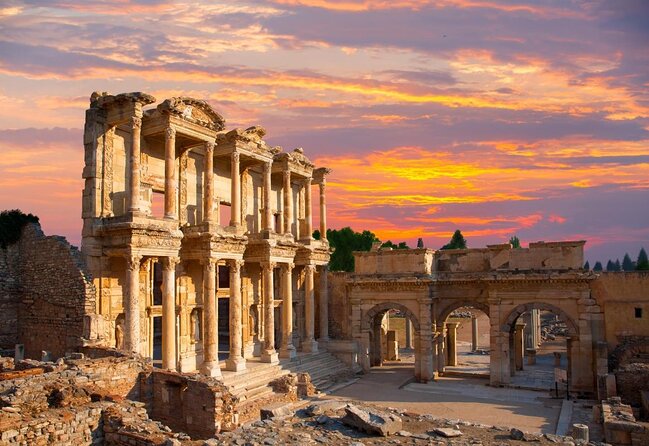
- Two major sights in two days: Visit Ephesus on day one, then Pamukkale and Hierapolis on day two.
- Private touring for up to 15 people: The $150 price is per group, not per person.
- A licensed guide and private driver are included: Guide Lori has been praised for her personable and informative approach.
- Lunch is included both days: Drinks and entrance tickets cost extra.
- The Temple of Artemis is free to visit: Only one column and scattered remains survive, but the stop adds useful context to Ephesus.
- You need to plan for walking and admission costs: Ephesus, Hierapolis, and the travertines are open-air sites with uneven surfaces and separate entry fees.
Why this two-day route works from Selçuk
Selçuk is the natural base for Ephesus, but Pamukkale lies farther inland near Denizli. Trying to connect the two by public transport can take planning, especially when you also want to visit the Virgin Mary’s House, the Temple of Artemis, and Şirince.
This tour solves that problem with private transportation in an air-conditioned vehicle. Pickup is offered, and the driver handles the road while your guide explains the places along the way. That arrangement matters most if you are traveling as a family, sharing the tour with friends, or carrying luggage between stops.
The tour costs $150 per group of up to 15 people. For one or two people, that is not a bargain compared with independent sightseeing. For a larger group, the arithmetic changes quickly. Even after adding entrance tickets and gratuities, the shared cost can make private transport a sensible choice.
You should also allow for the price of admission at the major archaeological sites. Ephesus, the House of the Virgin Mary, Pamukkale, and Hierapolis are listed with entrance fees not included. The Temple of Artemis and the brief stops in Şirince, Kuşadası, and Selçuk do not add an admission charge according to the tour details.
More Pamukkale and Hierapolis Tours from Turkey:
- From Antalya/Kemer: Pamukkale & Hierapolis Day Trip w/Meals
★ 4.5 · 2,196 reviews - Pamukkale Hierapolis and Cleopatra’s Pool Tour with lunch from Antalya
★ 5.0 · 2,188 reviews - From Antalya/Kemer: Pamukkale and Hierapolis Tour with Lunch
★ 4.6 · 1,853 reviews
Day one begins among the ruins of Ephesus
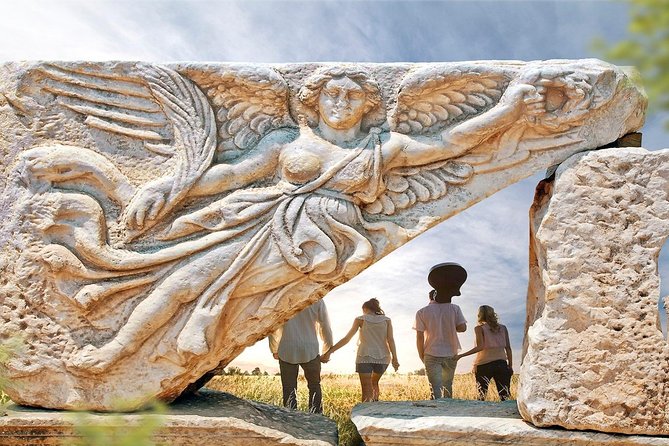
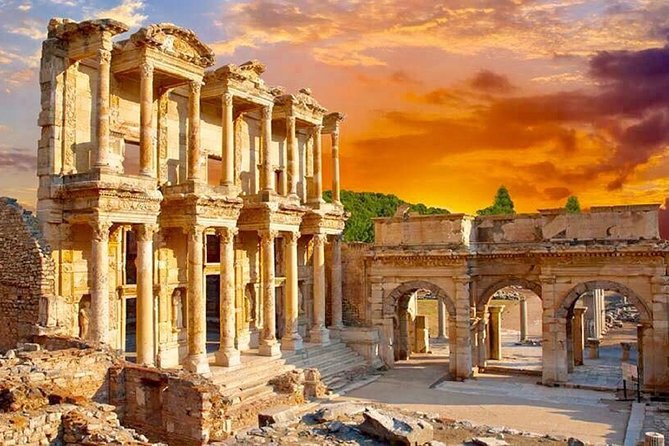
Ephesus is the centerpiece of the first day. At its height in the first century BC, it was one of the largest and most powerful cities in the Mediterranean world, rivaled in importance by Rome. The remains today give you a clear sense of its scale, even though much of the city is gone.
You can expect about two hours at the site. That is enough to see the major streets and reconstructed monuments, but you will need to keep moving. Wear practical shoes and bring sun protection, since the visit takes place outdoors and the ancient stone surfaces offer little comfort under strong sun.
The remains include impressive public buildings, roads, columns, and monuments connected with the city’s religious and civic life. Ephesus is especially rewarding with a guide because bare stones do not always explain themselves. A good guide can help you picture how the city functioned, where people gathered, and why the surviving buildings mattered.
A two-hour visit also requires sensible priorities. You will not study every corner of the ancient city. Instead, focus on the main route, listen for the stories that give the ruins meaning, and leave time for photographs without letting the camera turn the visit into a race.
The entry fee is separate. Confirm the current amount when you book or before the visit, since admission prices can change.
Meryemana brings a quieter, sacred stop
The House of the Virgin Mary, known in Turkish as Meryemana, sits near Ephesus and takes about an hour on this route. It is regarded by many Christians and Muslims as the place where Mary spent her final days. The stone house has been restored and now serves as a chapel.
The site is more subdued than Ephesus. You come here for its religious importance and atmosphere rather than for a large set of ruins. Remains of the chapel are said to reach back to the sixth century, and the site continues to serve as a place of worship.
You should approach this stop with respect. It is an active sacred place, not simply another archaeological attraction. The tour details note that the Lazarist Fathers conduct Mass there each day, which helps explain why the visit feels different from a walk through ancient streets.
Admission is not included. The stop may appeal most to people interested in Christian tradition, pilgrimage sites, and the overlap of religious memory with archaeology. If your main interest is classical architecture, Ephesus will likely be the stronger part of the day.
The Temple of Artemis is small but important
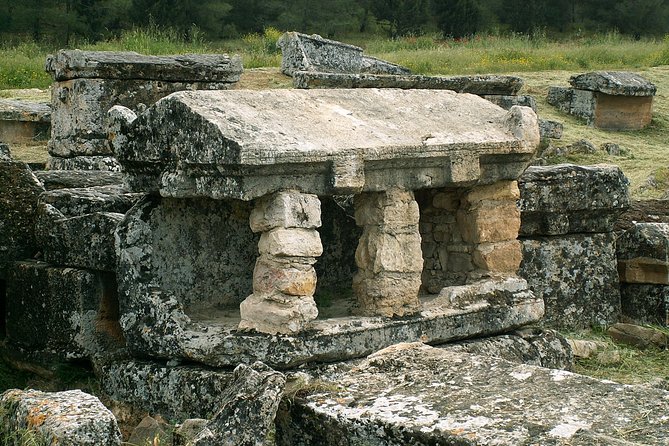
The Temple of Artemis once ranked among the Seven Wonders of the Ancient World. Today, the site near Selçuk is modest: one standing column and a handful of marble remains mark what was once a major Greek temple.
That contrast can surprise you. Do not arrive expecting a complete monument. The temple was rebuilt several times and damaged by both natural forces and human action. Many surviving fragments are now held elsewhere, including in the British Museum.
So why stop? Because the location connects Ephesus with the cult of Artemis, one of the key religious forces in the ancient city. From the temple area, you can also see the remains of St. John’s Basilica on a hill near Selçuk, adding another layer to the region’s long religious story.
The visit takes about 30 minutes and has no admission fee. That is a fair amount of time for a site with so little standing structure. Your guide can make the difference here by helping you understand what is missing and why the site still matters.
More Private Hot Spring Tours in Turkey:
- Private 4 Days Turkey Tour from Istanbul to Cappadocia, Ephesus, Pamukkale
★ 5.0 · 80 reviews - Full-day Private Pamukkale Tour from Kusadasi with Lunch
★ 5.0 · 43 reviews - Pamukkale Private Shore Excursion From Kusadasi Port
★ 5.0 · 36 reviews - 8- Day Private Tour : Istanbul, Cappadocia, Ephesus, Pamukkale
★ 5.0 · 30 reviews
Şirince offers a change of pace
Şirince is a small mountain village with whitewashed homes, olive groves, cafés, and fruit-based wineries. Its name means pleasant in Turkish, and the village is known for its connection to the history of Ephesus and the Greek population that once lived in the area.
The tour description gives this stop only a very brief amount of time, so you should not expect a full village visit or a relaxed tasting session. The timing may function more as a quick look at the setting than as a major part of the day.
If you want to browse, eat, or explore the Church of St. John the Baptist, ask how much time is actually available before the day begins. The church is known for Byzantine frescoes, though it has not been well maintained. Şirince can also become crowded on weekends, which may make a short stop feel even shorter.
Still, the village adds something Ephesus cannot: a living community in a green mountain setting. It breaks up the ruins and gives you a glimpse of the region beyond the famous monuments.
Kuşadası and Selçuk add local context
Kuşadası is included as a short stop of about 20 minutes. The Aegean port city sits beside a gulf and is known for Güvercinada, or Pigeon Island, which is joined to the mainland by a causeway.
With only 20 minutes, treat this as a quick orientation rather than a full city tour. You may see the waterfront area or gain a sense of the town’s position on the Aegean, but the schedule does not allow much independent exploration.
Selçuk itself has a long connection with Ephesus and the worship of Artemis. Settlement on Ayasuluk Hill reaches back to the Bronze Age, while later communities connected the area with St. John. The town’s older Byzantine name, Ayios Theologos, refers to the apostle and his burial place on the hill.
These short stops make sense if you want a broad view of the region. They are less satisfying if your priority is extended time in every town. The route favors range over lingering.
Day two brings the white terraces of Pamukkale
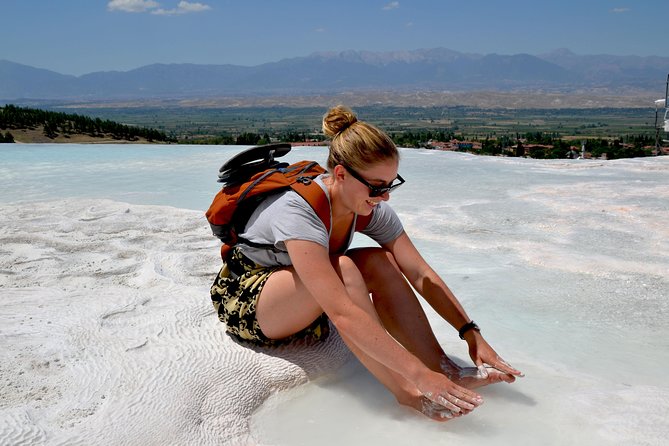
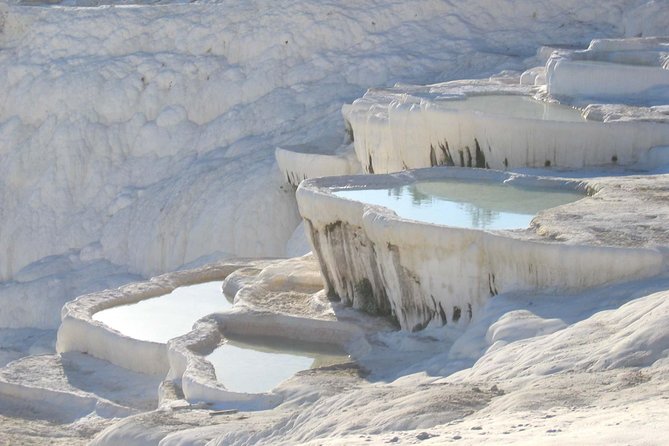
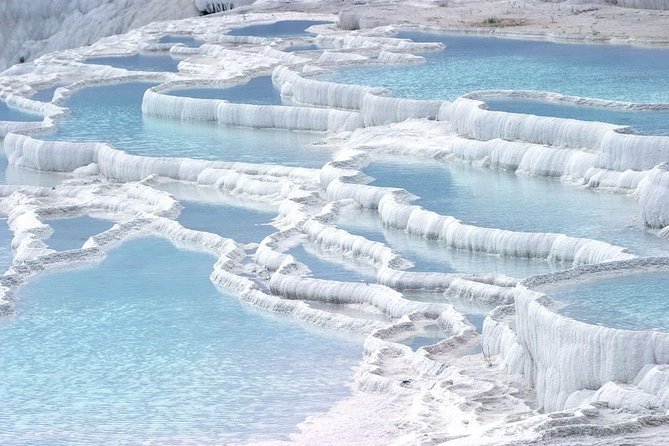
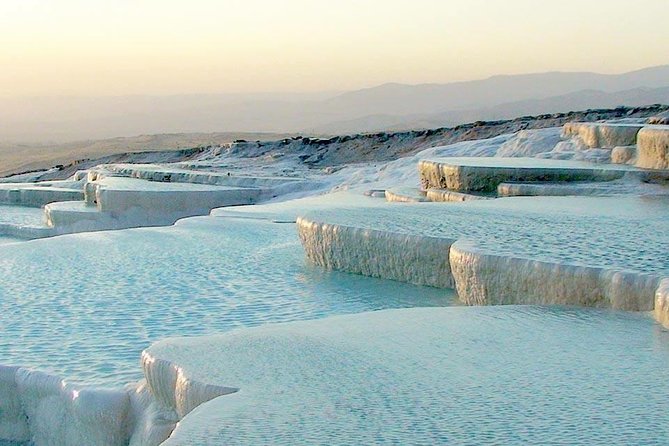
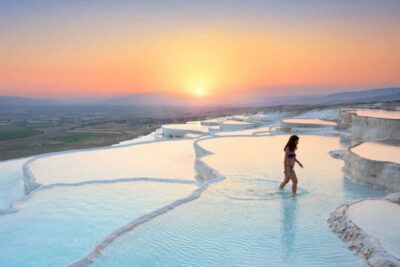
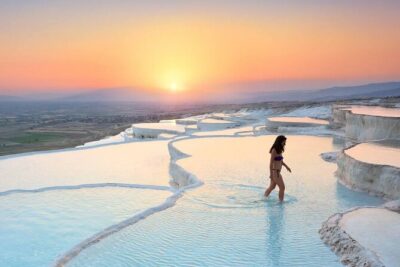
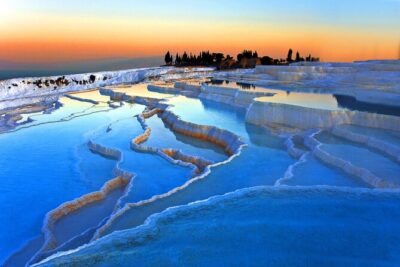
Pamukkale translates as Cotton Castle, a fitting name for the bright white mineral terraces covering the hillside. Hot spring water carries minerals that harden as the water meets the air, forming the pale travertines and shallow pools.
This is the visual high point of the second day. The white terraces and blue-green water look unusual even in photographs, and the effect is stronger when you see the stone formations spread across the hillside. The site is protected and recognized by UNESCO, so follow local rules about where you can walk and where you may enter the water.
The tour allows about two hours at Pamukkale Natural Park, followed by shorter visits connected with Hierapolis and the thermal pools. Since the stops overlap, ask your guide how the timing will be arranged on the day. The listed schedule includes several separate entries for Pamukkale and Hierapolis, but they form one connected archaeological and natural area.
The terraces are not just a photo stop. The mineral deposits record the work of hot water over many centuries, while the springs explain why people have come here for rest and treatment since antiquity. You can enjoy the sight on its own, but the guide’s explanation adds useful context.
Admission is not included. Also expect walking on uneven ground and possibly wet surfaces near the pools. Footwear that you can manage comfortably on stone is a better choice than anything delicate.
Hierapolis shows why people came to the springs
Above and around the terraces lie the ruins of Hierapolis, an ancient spa city built around the hot springs. The site includes a large necropolis with about 1,200 graves, making it one of the largest ancient burial areas in Anatolia.
The contrast is striking. At Pamukkale, your attention goes to water, minerals, and color. At Hierapolis, you see streets, stone buildings, tombs, and the remains of a city that grew because people valued the springs.
The archaeological museum receives about 30 minutes on the schedule. Another short stop covers Hierapolis and Pamukkale together. That is enough for an introduction, but not enough to inspect every monument in detail.
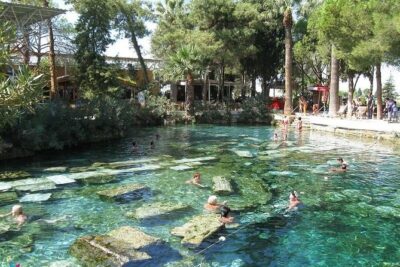
The Sacred Pool is one of the area’s best-known features. Shallow thermal water flows over ancient Roman ruins beneath the surface, creating an unusual mixture of bathing area and archaeological site. The tour details connect the springs with stories of Cleopatra, although you should treat that as part of the site’s long tradition rather than a proven personal connection.
The entry fee is separate, and the pool may have its own rules or charges. If swimming or bathing is important to you, ask your guide what is available during your visit rather than assuming it is included.
Guide quality matters more here than on a simple transfer
The tour includes a private licensed guide and a private driver. That is important because the experience is not only about getting from Selçuk to two famous places. Ephesus and Hierapolis make more sense when someone explains the buildings, religious practices, and changing cultures behind the stones.
The available feedback gives guide Lori particular credit for being personable and well informed. That is the sort of guide you want on this route: someone who can explain the main monuments clearly, answer questions, and keep a full day moving without making it feel like a lecture.
The tour may operate with a multilingual guide. If language is important to your group, confirm the available language before booking. A private format gives you a better chance to ask questions and adjust your attention than a large shared coach tour.
Lunch is included on both days, according to the tour details. Drinks are not included, so keep money available for beverages. Gratuities for the guide and driver are also separate.
Who will get the most from this tour
I would choose this tour if you want the major sights in a short stay and prefer not to coordinate regional transportation. It is also a strong fit for a group of friends or family members who can divide the $150 cost.
You will get the most from it if you:
- Have two days available from a base in or near Selçuk
- Want both archaeological sites and natural scenery
- Prefer a private vehicle to public transport
- Value a guide who can explain ancient sites
- Are comfortable with outdoor walking and a busy schedule
- Do not mind paying entrance fees separately
I would think twice if you want long, unhurried visits. Şirince, Kuşadası, and the smaller stops receive limited time, while even Ephesus and Pamukkale are introductions rather than exhaustive tours.
The tour is listed as suitable for most people, but the information does not provide detailed mobility guidance. Because the route includes ancient ruins, stone paths, and travertine surfaces, ask the provider about your specific needs before booking.
Booking advice and final verdict
This tour gives you an efficient two-day framework for western Turkey. The route is broad, the private format is useful, lunch is included, and the cost becomes attractive when shared by a larger group. The strongest parts are Ephesus, Pamukkale, and the explanation provided by a good guide such as Lori.
The weak point is the schedule’s brevity at several stops. You should also budget separately for entry tickets, drinks, and gratuities. If you want to see the essential sights without handling transport, I would book it. If your goal is slow archaeology, long village meals, or a full day at each major site, arrange a more flexible private itinerary instead.
FAQ
How long is the Private Pamukkale and Ephesus Tour?
The experience lasts approximately two days. Day one covers Ephesus and nearby attractions around Selçuk, while day two covers Pamukkale and Hierapolis.
How much does the tour cost?
The price is $150 per group, with up to 15 people included in that group rate.
Are entrance fees included?
No. Entrance fees to the listed sights are not included in the tour price.
Is lunch included?
Yes. Lunch is included on both days. Drinks are not included unless specifically stated.
Is this a private tour?
Yes. Only your group participates in the private tour or activity.
Can I cancel for a full refund?
Yes, if you cancel at least 24 hours before the experience start time. Cancellations or changes made less than 24 hours before the start time are not accepted for a refund.
Just added around Turkey
- From Istanbul: Cappadocia Konya Pamukkale Ephesus 7 Nights★ 4.5 · 8 reviews
- Experience the Traditional Whirling Dervish Ceremony in Pamukkale★ 5.0 · 3 reviews
- Pamukkale & Lake Salda: Experience the Wonders of Nature★ 4.5 · 21 reviews
- Alanya: Pamukkale and Salda Lake★ 4.5 · 4 reviews
- Side: Pamukkale Tour w/Breakfast, Lunch, Dinner★ 3.5 · 2 reviews
- Side Express Pamukkale &Hierapolis Day Trip w/Lunch & Pickup★ 4.5 · 22 reviews
- Full Day Salda + Pamukkale Tour from Side/Manavgat★ 3.5 · 5 reviews
- Side Pamukkale & Hierapolis Day Trip w/Breakfast & Hotel Pickup★ 4.5 · 3 reviews
Pamukkale & Hierapolis Tours, compared.
Pamukkale Hierapolis and Cleopatra’s Pool Tour with lunch from Antalya
Read our review →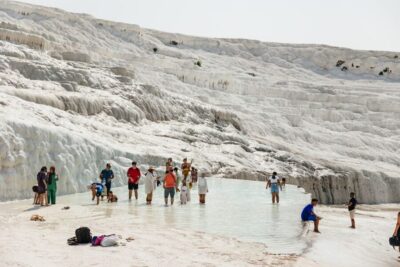
Antalya Pamukkale Hot Springs & Hierapolis Tour With Lunch
Read our review →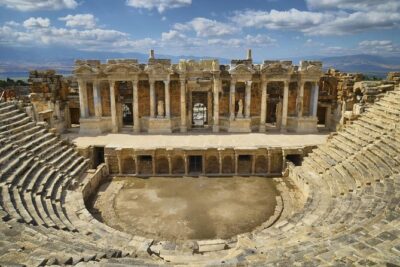

Full-Day Tour of Pamukkale from Antalya with Lunch
Read our review →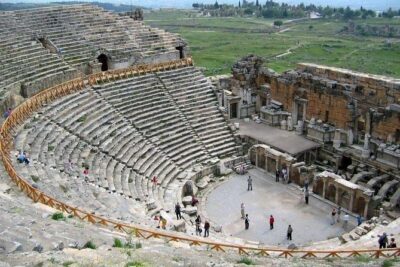
Full-Day Tour to Pamukkale From Marmaris w/ Breakfast & Lunch
Read our review →Browse the lists this tour appears in