REVIEW · TURKEY
Cappadocia, Konya, Pamukkale and Ephesus Tour
Cappadocia’s fairy chimneys, Konya’s Mevlana Museum, Pamukkale’s white terraces, and Ephesus all land on one route here. You move from volcanic rock valleys to Roman streets in a week, with airport pickup and hotels arranged along the way. The variety is the main attraction.
I like the private format, since only your own group takes part and the schedule can be adjusted for families. I also like that the long transfers are handled by private vehicle, while breakfast, six hotel nights, guiding, and many entrance fees are included. Guides speak English, and the operator has made reasonable changes for families with children.
The tradeoff is pace. You cover a large part of Turkey, and several days include long drives, early starts, or extended walks. Lunch, dinner, drinks, Cleopatra’s Thermal Pool, and the Cappadocia balloon flight are extra, so the advertised price is not the final cost of every popular add-on.
Key points to know before booking
- Seven days connect four major destinations: Cappadocia, Konya, Pamukkale, and Ephesus, with Pergamon added near the Aegean coast.
- Private transport keeps the route simple: airport pickup, hotel transfers, sightseeing drives, and final transfer to İzmir Airport or Kuşadası bus station are included.
- Cappadocia gets three substantial sightseeing days: you visit its valleys, rock churches, underground city, workshops, and viewpoints.
- The route includes real walking: Ihlara Valley involves a roughly 3.5-kilometer hike, while Ephesus and Hierapolis require time on uneven ancient surfaces.
- The package covers six breakfasts and six hotel nights: meals beyond breakfast are not included.
- Popular extras cost more: hot-air balloon flights and swimming in Cleopatra’s Antique Thermal Pool are optional and charged separately.
A fast but rewarding route through Turkey
This is a sightseeing-heavy trip for someone who wants the major names without piecing together domestic transfers, hotels, and local tours. You begin at either Nevşehir or Kayseri Airport in Cappadocia and finish near Selçuk, İzmir Airport, or the Kuşadası bus station.
The route is not a slow, leisurely circuit. You change regions several times, and the drive from Cappadocia to Konya takes about three hours. Konya to Pamukkale takes about three hours, and Pamukkale to Kuşadası takes another three hours. That is a fair amount of road time, but private transport makes those stretches easier than arranging separate buses or taxis.
At $2,315.20 per person, the cost is high at first glance. The value depends on how much planning you would otherwise pay for. Six nights of accommodation, private transport, airport and hotel transfers, six breakfasts, a professional guide, national park fees, and many site admissions are included. You still need to budget for lunch, dinner, drinks, souvenirs, the balloon flight, and Cleopatra’s Pool.
This works best if you value convenience and a private schedule more than finding the lowest possible price.
More Pamukkale and Hierapolis Tours from Turkey:
- From Antalya/Kemer: Pamukkale & Hierapolis Day Trip w/Meals
★ 4.5 · 2,196 reviews - Pamukkale Hierapolis and Cleopatra’s Pool Tour with lunch from Antalya
★ 5.0 · 2,188 reviews - From Antalya/Kemer: Pamukkale and Hierapolis Tour with Lunch
★ 4.6 · 1,853 reviews
Day 1: A simple arrival in Cappadocia
Your first day is deliberately light. You are met at either Cappadocia airport, Nevşehir or Kayseri, and driven to your hotel in the Cappadocia area. The transfer takes about an hour.
That airport pickup matters here. Cappadocia’s main villages and sightseeing areas are spread out, and arriving without a prearranged ride can make the first afternoon needlessly awkward. You have the rest of the day to settle in, though no sightseeing stop is scheduled.
The six-night accommodation is included, but the supplied details do not name the hotels or specify their exact standard. Ask for those details before booking if your room, location, or hotel category matters to you.
Day 2: Fairy chimneys, workshops, and Uchisar
The first full sightseeing day focuses on the familiar Cappadocia scenes. At Uchisar Castle, you look across the region from its highest point. The rock citadel contains tunnels, graves, and churches, giving you a useful introduction to how people adapted these soft volcanic formations for shelter and worship.
You then visit Zelve Open Air Museum, where pointed fairy chimneys and carved spaces fill an outdoor site near Pasabag. Allow about 50 minutes here. The time is enough for an overview, but you may want to keep your expectations realistic: this is a guided highlights stop, not an entire afternoon of slow exploration.
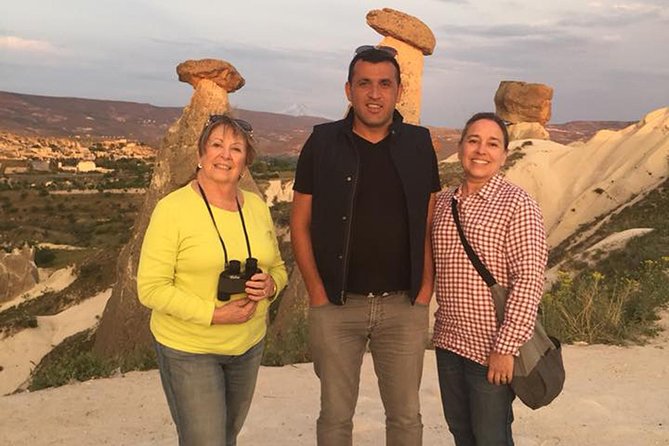
Pasabag, also called Pasha’s Vineyard, is the place for the famous three-headed fairy chimneys. These rock formations are among Cappadocia’s most memorable sights, and the short 30-minute visit is well suited to photographs.
The itinerary then shifts from geology to local crafts. At the Bezirhane Culture, Arts and Ceramics Center, you learn about clay from the Kızılırmak River and volcanic hills. The area has long been associated with pottery, and the stop gives you a look at how red and white clays are shaped on spinning wheels.
A rug workshop follows. Cappadocian carpets use patterns as symbols of wishes, beliefs, and personal feeling. This is also a commercial stop, so you should feel free to watch the demonstration without buying. If you are considering a purchase, ask about price, materials, size, shipping, and return arrangements before committing.
The day continues through Ürgüp, known for cone-shaped fairy chimneys capped by harder rock. The local description of the formations as mother, father, and child gives the stop a touch of folklore, but the main appeal is the unusual rock shape itself.
The listed stops are short, mostly 30 minutes. That keeps the day moving and lets you see a lot, though it leaves little room for lingering at any one site. You return to the hotel after a full day of views, carved rock, and craft demonstrations.
Day 3: An underground city and the Ihlara Valley
Day three starts around 9:15 a.m. with a Göreme panoramic viewpoint. Your guide explains how volcanic activity and erosion formed Cappadocia’s fairy chimneys, then gives you time for photographs.
At Derinkuyu Underground City, you spend about an hour below ground. The complex was first used by local people as a natural deep-freeze area and later served as shelter during periods of danger. The narrow passages and enclosed rooms are memorable, but they may feel difficult if you dislike tight spaces or uneven footing.
Next comes Ihlara Valley, one of the more active parts of the tour. The canyon was formed by volcanic activity near Mount Hasan, followed by the long erosion of the Melendiz River. The valley reaches about 14 kilometers in length, while the scheduled hike covers roughly 3.5 kilometers and lasts about 75 minutes.
You pass carved churches and painted interiors linked to Christian communities that once lived in sections of the valley. This is a better stop for understanding how Cappadocia’s natural formations shaped daily life, but it requires proper shoes and a willingness to walk. A restaurant lunch follows, though the lunch itself is not included in the tour price.
Selime Monastery comes next. From a distance it resembles a fortress, but inside are churches, chapels, bedrooms, storage rooms, shelters, and a large cathedral. The climb can be tiring, especially after Ihlara Valley, so take the approach at your own pace.
At Pigeon Valley, you learn why pigeons mattered to Cappadocian farmers. People carved nesting spaces into the valley walls, using pigeon eggs and droppings for various purposes. It is a short stop, but the pigeon houses help you see the region as a working place rather than only a collection of scenic rocks.
The final visit is an onyx workshop in Uchisar. You see how volcanic stone is shaped and hear about its different colors and mineral content. As with the rug stop, treat it as a craft demonstration first and a shopping opportunity second.
After the sightseeing ends, you drive about three hours to Konya. This is a long day followed by a transfer, so it is one of the points where the private vehicle earns its keep.
Same place, a different kind of soak:
- Antalya Pamukkale Hot Springs & Hierapolis Tour With Lunch
★ 5.0 · 1,092 reviews - Pamukkale Tour from Izmir
★ 5.0 · 806 reviews - Full-Day Tour of Pamukkale from Antalya with Lunch
★ 5.0 · 640 reviews - Antalya: Full-Day Pamukkale and Hierapolis Tour & Lunch
★ 4.2 · 589 reviews
Day 4: Rumi, Seljuk Konya, and the road to Pamukkale
Konya begins with the Mevlana Museum, home to the tomb of Rumi and an important Muslim pilgrimage site. The visit lasts about an hour. It is a quieter cultural stop than Cappadocia’s rock valleys, and you should dress and behave respectfully in this religious setting.
You also visit the Ottoman-era Sultan Selim Mosque. After lunch at a traditional Turkish restaurant, the tour continues to Alaeddin Hill in central Konya. The hill is crowned by Alaeddin Mosque and includes the remains of the Seljuk sultans’ palace.
This is a compact introduction to Konya rather than a full city tour. If you are especially interested in Rumi, Sufi traditions, or Seljuk architecture, you may wish to ask how much free time is available around the scheduled visits. The supplied program does not include a separate whirling dervish performance.
After lunch, you drive roughly three hours to Pamukkale. The evening is mainly a transfer and hotel check-in, giving you a base for the next day’s ancient sites and thermal pools.
Day 5: Hierapolis and Pamukkale’s white terraces
The Pamukkale day starts at the red springs near Karahayit. From there, you enter Hierapolis through the North Gate and see a broad spread of ancient remains, including the Necropolis, Bath and Basilica, Frontinius Gate, Frontinius Street, Latrina, Byzantine Gate, Fountain of the Tritons, and Temple of Apollo.
The listed time for this section is about an hour, which is enough for a guided overview but not a slow archaeological study. Hierapolis is a large site, and the sequence of ruins makes more sense when your guide explains what each public building was used for.
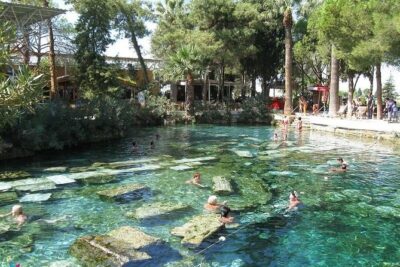
You then have free time at Cleopatra’s Antique Thermal Pool. Admission is extra. If you plan to swim, bring suitable clothing and allow for the additional fee. The pool is optional, so you can skip it and spend more time among the ruins or simply rest.
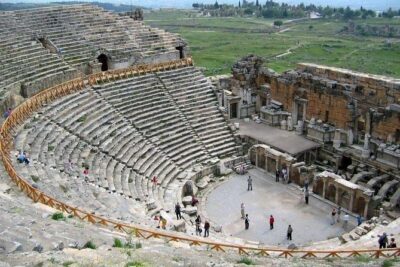
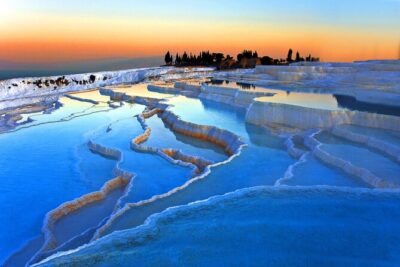
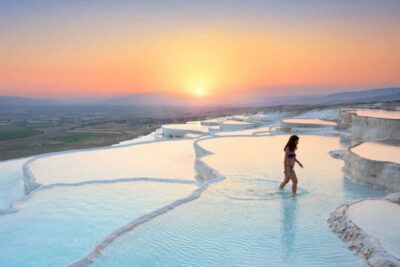
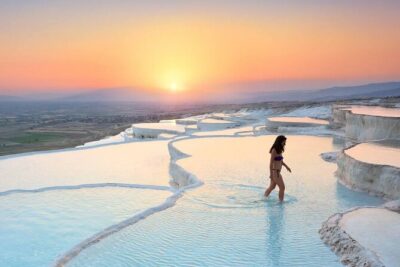
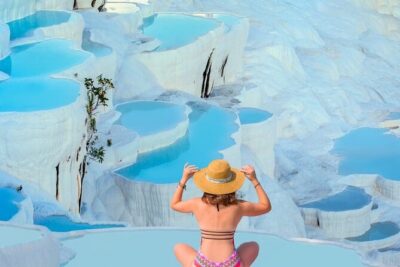
The large ancient theater is the final Hierapolis stop. It is unusually well preserved and once held about 25,000 people. Afterward, you reach Pamukkale’s travertines, the white calcium terraces that give the site its famous appearance.
You can wade in the water and take photographs, but follow the site’s instructions and expect to remove footwear in areas where that is required. The terraces are not a place for a quick roadside photograph. You need time to walk, pause, and handle the bright sun and smooth, wet surfaces carefully.
A late lunch follows, but lunch is not included. Then you return to the hotel before the roughly three-hour drive to Kuşadası. This is another full day, and the combination of walking, heat, and late transfer can be tiring.
Day 6: Pergamon’s hilltop ruins and ancient medicine
The next morning starts at about 9:30 a.m. You visit the Pergamon Acropolis and Asclepion, an ancient hospital and health center, with the remains of the Temple of Athena and its entrance structure.
Pergamon is a strong addition to the route because it broadens the ancient-world story beyond Ephesus. The Acropolis gives you a hilltop setting, while Asclepion shows how healing was practiced and presented in antiquity.
The excursion lasts about six hours, including transport and sightseeing. The supplied details do not specify the exact walking distance or whether every transfer to the upper site is handled the same way, so ask your guide about the day’s physical demands if that is important to you.
You return to the hotel afterward. Compared with the previous day, the later start makes this a slightly gentler schedule, though ancient sites still mean uneven ground and time outdoors.
Day 7: Mary’s House, Ephesus, and the final transfer
The last day begins from Kuşadası port and heads toward the House of the Virgin Mary. The winding road offers views toward Selçuk, the Byzantine fortress, and the Temple of Artemis. The small shrine sits in the Solmissos Mountains and is regarded by the Vatican as the Virgin Mary’s final resting place.
The visit takes about an hour. It is a religious site, so quiet behavior is appropriate. The stop also adds a different mood to the final day, moving from broad archaeological remains to a small place of pilgrimage.
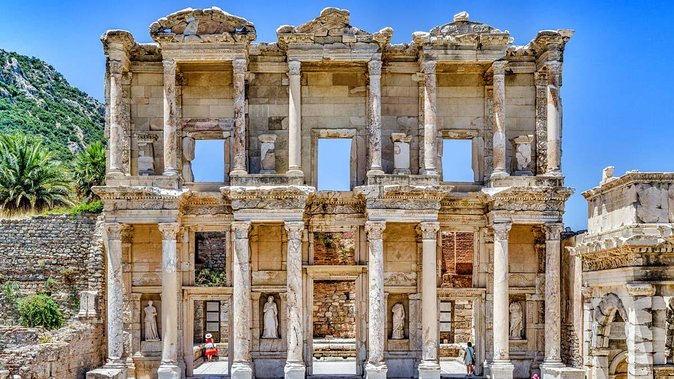
At Ephesus, you enter through Magnesia Gate and walk downhill through the former Roman provincial capital. The route includes the Temple of Hadrian, Trajan’s Fountain, the Odeon, and the Celsus Library, whose two-story Corinthian-style façade is one of the site’s great visual moments.
The Great Theater is another major stop. It held about 25,000 people and is still used for annual spring festivals. Ephesus is not a quick photo stop. The downhill route, exposed stone, and many preserved structures reward a slower pace, though the walk can be demanding in strong sun.
At the end of the day, you are driven to İzmir Airport or the Kuşadası bus station. Confirm your onward departure time carefully before booking, since the tour’s final transfer follows the Ephesus visit.
What the price includes, and what it does not
The package includes:
- Six nights of accommodation
- Six breakfasts
- Private vehicle transport
- Hotel and airport pickup and drop-off
- A professional guide
- National park fees
- Many listed entrance fees
- Taxes, fees, and handling charges
You pay separately for lunch, dinner, drinks, alcoholic beverages, souvenir photographs, the hot-air balloon flight, and Cleopatra’s Thermal Pool.
The hot-air balloon is the most famous optional extra in Cappadocia, but it is not part of the stated package. If it is a priority, ask about price, availability, pickup time, and what happens if weather affects the flight before you reserve the tour.
The private arrangement is especially useful for families. Children must be accompanied by an adult, and at least two people are required per booking. Most people can take part, but the underground city, Ihlara hike, Selime climb, travertines, and Ephesus walk make this a poor match for anyone seeking a low-effort holiday.
Who should book this seven-day tour
I would choose this trip if you have one week, want Turkey’s major sights, and prefer one organized route over several separate bookings. It is also a good fit for families who value direct transfers and the possibility of reasonable schedule adjustments.
I would hesitate if you want long free periods, independent meals, or time to explore each town on your own. The itinerary gives you a strong first look, but it does not leave much room for spontaneous wandering.
The provider’s service record is a positive sign. English-speaking guides are described as welcoming and helpful, and family requests have been accommodated. Still, ask for the hotel names, vehicle details, guide arrangements, and the exact list of included admissions before paying the full amount.
Should you book it?
Book this tour if your priority is seeing Cappadocia, Konya, Pamukkale, Pergamon, and Ephesus in one carefully connected trip. The route is broad, the transfers are handled, and the private format gives you more flexibility than a standard group departure.
Skip it if your ideal holiday means staying several nights in each place or keeping all meals and extras inside one fixed price. At $2,315.20 per person, it is a convenience-focused purchase, not a budget tour. For a first visit with limited time, that convenience can be worth the premium.
FAQ
How long is the tour?
The tour lasts approximately seven days and includes six nights of accommodation.
Where does the tour begin?
It begins with pickup from either Nevşehir or Kayseri Airport in Cappadocia.
Where does the tour finish?
After the Ephesus visit, you are driven to İzmir Airport or the Kuşadası bus station.
Is this a private tour?
Yes. Only your own group participates in the private tour or activity.
How many people are required to book?
A minimum of two people is required per booking.
Are hotel stays included?
Yes. Six nights of accommodation are included, although specific hotel names are not provided in the tour details.
Are meals included?
Six breakfasts are included. Lunch, dinner, drinks, and alcoholic beverages are not included.
Is a hot-air balloon flight included?
No. A hot-air balloon flight over Cappadocia is an optional extra.
Does Cleopatra’s Thermal Pool cost extra?
Yes. Swimming at Cleopatra’s Antique Thermal Pool requires an additional admission fee.
Can children join the tour?
Yes, but children must be accompanied by an adult. Most people can participate, though the itinerary includes walking, stairs, an underground city, and uneven ancient sites.
Just added around Turkey
- From Istanbul: Cappadocia Konya Pamukkale Ephesus 7 Nights★ 4.5 · 8 reviews
- Experience the Traditional Whirling Dervish Ceremony in Pamukkale★ 5.0 · 3 reviews
- Pamukkale & Lake Salda: Experience the Wonders of Nature★ 4.5 · 21 reviews
- Alanya: Pamukkale and Salda Lake★ 4.5 · 4 reviews
- Side: Pamukkale Tour w/Breakfast, Lunch, Dinner★ 3.5 · 2 reviews
- Side Express Pamukkale &Hierapolis Day Trip w/Lunch & Pickup★ 4.5 · 22 reviews
- Full Day Salda + Pamukkale Tour from Side/Manavgat★ 3.5 · 5 reviews
- Side Pamukkale & Hierapolis Day Trip w/Breakfast & Hotel Pickup★ 4.5 · 3 reviews
Pamukkale & Hierapolis Tours, compared.
Pamukkale Hierapolis and Cleopatra’s Pool Tour with lunch from Antalya
Read our review →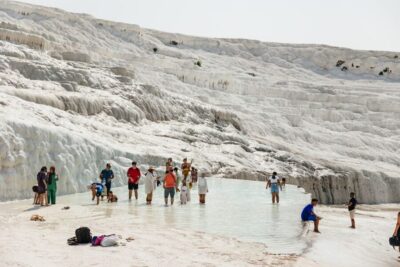
Antalya Pamukkale Hot Springs & Hierapolis Tour With Lunch
Read our review →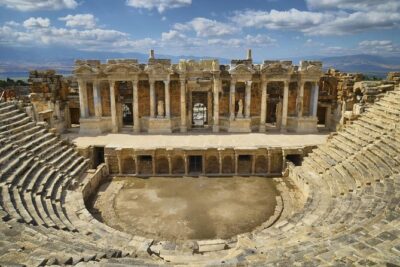
Full-Day Tour of Pamukkale from Antalya with Lunch
Read our review →