
REVIEW · SOFIA
Sofia Hidden Gems: Small-Group Walking Tour with Tram Ride
Sofia reveals its layers quickly on this tour: Roman Serdica sits below modern streets, a fourth-century church shares the center with Ottoman and socialist-era landmarks, and a short tram or metro ride links the old sights. I like the mix of famous places and less obvious interiors, especially the National Library and Sofia University.
I also like the small group, capped at 10, and the personal approach of guide Peter, who has been praised for answering questions, adding bonus stops, and waiting while people shop for souvenirs. The main consideration is pace: this is a two-to-three-hour city walk with many stops, so you get an excellent overview but only brief visits at most places.
Key points at a glance
- Roman Sofia under your feet: See the Rotunda of St. George and the Ancient Serdica complex, including a section of the old main street.
- Two worthwhile interior visits: Enter the National Library and Sofia University rather than viewing them only from outside.
- A short ride adds local texture: Your city transport card covers a brief tram or metro journey between parts of central Sofia.
- A compact group: The maximum of 10 people gives Peter room to answer questions and adjust the walk.
- A strong city-center finish: The route ends at Sofia Central Market Hall, near public transport and the Women’s Market area.
Why this Sofia walk works so well
Sofia is unusually good for a compact history walk. You can move from late-antique ruins to a medieval church, an Ottoman mosque, a Jewish synagogue, grand public buildings, and a modern market without spending much time in transit.
That is the strength of this experience. It is not just a parade of churches and monuments. The route shows how Sofia changed from Roman Serdica to an Orthodox capital, an Ottoman city, a modern European capital, and a socialist state center.
You should expect about two to three hours, including the time spent moving from place to place. The walking is broken up by short stops, and the tram or metro ride gives your feet a brief rest while showing you how residents move around the city.
The price is $45.66 per person. I consider that fair if you want a guide to explain the connections between the sights and take you inside places you might otherwise pass by. It is less attractive if you prefer to move at your own speed or spend a long time in museums. Most stops last only five to 15 minutes, and admission is listed as free, so the value comes mainly from Peter’s guiding, the route design, the transport card, and the inside visits.
More Walking Tours in Bulgaria:
- Sofia: Seven Rila Lakes Snowshoe Walk & Thermal Spring Pools
★ 3.9 · 79 reviews - Rotorua: Hell’s Gate Outdoor Mud Spa & Guided Walk
★ 4.7 · 1,140 reviews - Rotorua: Hell’s Gate Geothermal Walk
★ 4.4 · 217 reviews
Saint Sofia Church and Alexander Nevsky Cathedral
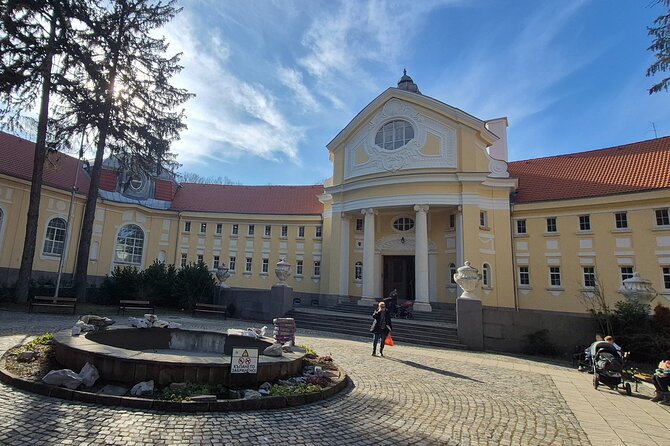
The walk begins at Saint Sofia Church on Paris Street. This is one of Sofia’s oldest churches, dating to the fourth century. The city eventually took its name from this church, replacing the older name Serdika.
The short 10-minute stop gives you a useful starting point. Sofia’s story does not begin with its modern boulevards or nineteenth-century public buildings. It begins with an ancient settlement and a long religious tradition. The predecessor to the present church was linked to the Council of Serdica, probably held in 343 and attended by 316 bishops.
You then reach St. Alexander Nevsky Cathedral, Sofia’s great Bulgarian Orthodox landmark. Its Neo-Byzantine design and enormous scale make it one of the largest Christian church buildings in the world by volume.
Ten minutes is enough to appreciate the outside and hear why the cathedral matters, but it is not enough for a slow look at every detail. If you want extended time inside, you may need to return on your own. That is typical of this walk: the guide gives you the framework, then you can decide which places deserve a longer second visit.
Art, books, and Sofia University
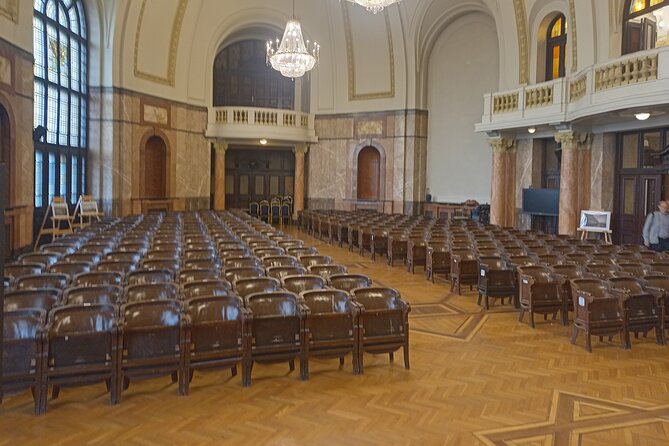
One of the more unusual parts of the route is the chance to see the Bulgarian National Library from inside. The library holds nearly 8.5 million documents and receives about 70,000 new publications each year.
That makes this stop more than an attractive public building. It gives you a sense of Bulgaria’s written culture and the scale of the country’s national collection. The visit lasts about 10 minutes, so do not expect a full library tour. Still, entering the building adds variety to a route otherwise filled with churches, streets, and monuments.
The walk also visits Sofia University St. Kliment Ohridski. Founded as Bulgaria’s first higher educational institution, the university grew from older Bulgarian cultural and educational traditions. Its history reaches back to the period of the Bulgarian Renaissance and the renewed push for higher education after the 1878 Liberation.
I especially like the inclusion of these two stops because they make Sofia feel like a living capital rather than an outdoor museum. You see where books are preserved and where higher education developed. Peter’s ability to answer questions about Bulgaria is useful here, particularly if you want context beyond dates and architectural labels.
The tour also passes Kvadrat 500, the National Gallery’s largest building. It opened in 2015 and displays about 1,700 works in 28 halls across four levels, drawn from a collection of more than 42,000 pieces. The displays cover Bulgarian art from the mid-nineteenth century onward, European art from the fifteenth to nineteenth centuries, and works from Asia, Africa, and America.
You should treat Kvadrat 500 as a passing point rather than a full museum visit. There is no time in a three-hour walk to explore its galleries properly. If art is a priority, note the location and return later.
Public buildings, opera, and the National Theatre
As the route continues, Peter points out several buildings that help explain Sofia’s civic identity. One neo-Renaissance structure was designed by Constantin Yovanovic, an architect who also designed the Serbian Assembly. It was built between 1884 and 1886.
The supplied route does not name this building, so the useful point is its style and period. Sofia’s public architecture changed rapidly after Bulgaria’s liberation, and this building reflects the city’s attempt to create a modern European capital.
You also hear about the beginnings of Bulgarian opera. In 1890, Dragomir Kazakov, Ivan Slavkov, and Angel Bukoreshtliev organized the first Bulgarian opera troupe. Performances included full operas and excerpts, with Bulgarian, Czech, and Italian participants supported by several orchestras and a piano.
That story leads naturally to the National Theatre. Completed in 1906 and opened on January 3, 1907, the building was designed by Ferdinand Fellner and Hermann Helmer, two widely used European theatre architects of the period. The auditorium seats 848, and its ceiling and walls were painted by Vienna-based artist Rudolf Fuchs.
These stops are brief, but they give you a better feel for Sofia’s cultural ambitions. You are not only looking at facades. You are seeing the institutions that helped shape Bulgaria’s public life.
Same place, a different kind of soak:
- Bansko: Villa Victoria Thermal Pool Escape
★ 4.4 · 114 reviews - Full-day Rila Mountains, Seven Lakes Hike, and Hot Springs Tour from Sofia
★ 4.5 · 70 reviews - From Sofia: 7 Rila Lakes Hiking & Thermal Spa Day Tour
★ 4.3 · 46 reviews - Seven Rila Lakes Snowshoe Hike and Thermal Baths Full-Day Tour from Sofia
★ 4.5 · 43 reviews
The Largo and Roman Serdica below the city
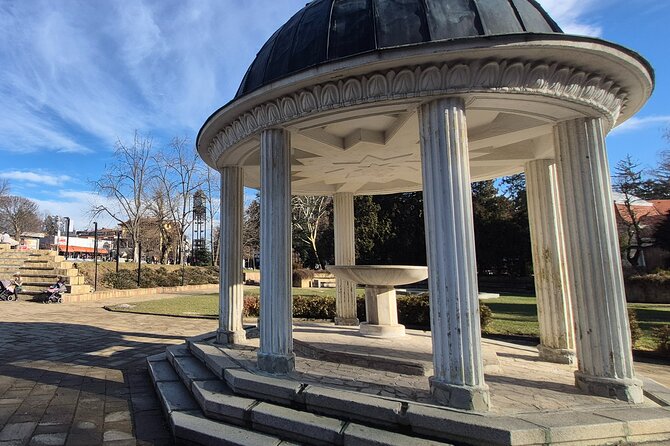
The Largo is one of Sofia’s clearest examples of historical layers sharing the same space. The three large Socialist Classicism buildings were planned and built in the 1950s as a new representative center for the capital.
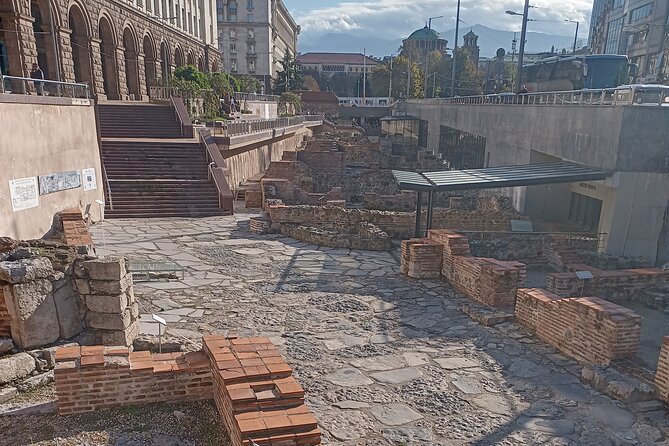
Below Nezavisimost Square, the Ancient Serdica Archaeological Complex exposes the Roman city. The preserved remains include part of the decumanus maximus, one of Serdica’s principal east-west streets. You can also see a large residential building that filled an entire city block, with small shops where residents and passersby could buy food and goods.
This is one of the most satisfying stops because the archaeology is integrated into the center of present-day Sofia. You do not have to travel to a distant archaeological park to see the Roman street plan. The ancient remains sit directly beneath the modern city.
The visit lasts about 15 minutes, the longest scheduled stop on the route. That is still a quick look, but enough to understand the scale of Roman Serdica and the way the modern center was built over it.
The red-brick Rotunda of St. George
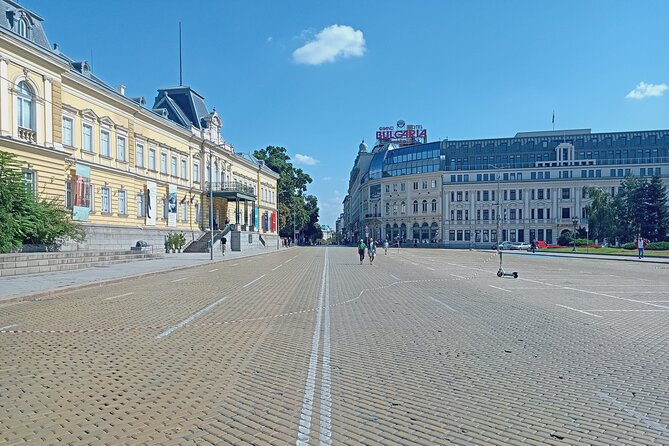
The Rotunda of St. George is one of Sofia’s most memorable buildings. This small red-brick structure was built in the early fourth century, originally as part of Roman baths. It later became a church inside the walls of Serdica.
At only five minutes, the stop is short. Yet the building earns its place because it is considered the oldest building in modern Sofia and remains an active part of the Bulgarian Orthodox tradition.
The rotunda can be easy to miss among larger monuments and modern streets. A guide helps you understand why this modest structure matters. It is a good reminder that Sofia’s oldest sights are not always the biggest or most decorated.
Mineral baths, synagogue, mosque, and the market
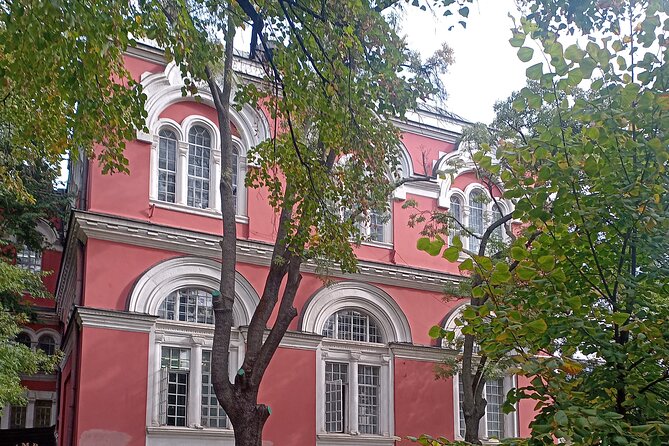
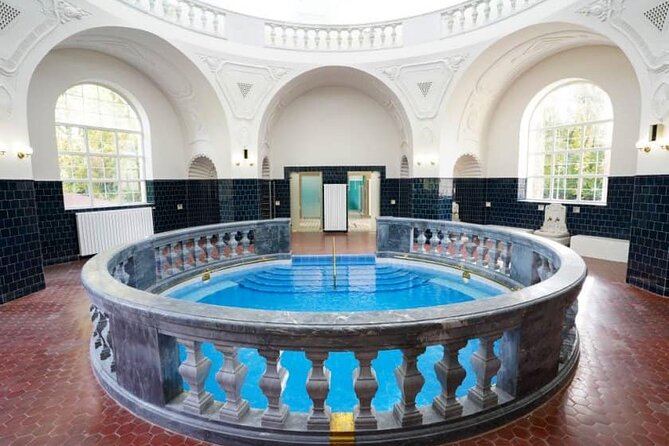
The Central Mineral Baths provide another view of Sofia’s identity. The present building was designed in the Vienna Secession style, but its decoration also uses Bulgarian, Byzantine, and Eastern Orthodox elements. It was designed by Petko Momchilov and Friedrich Grünanger in 1904 and 1905, then approved in 1906.
The building reflects Sofia’s long connection with mineral springs. The route does not include a bathing experience, so you are seeing the architecture and learning about the site rather than using the baths.
Nearby, the Central Sofia Synagogue adds the city’s Jewish heritage to the walk. The building was created in the early twentieth century after the Jewish community raised funds and invited architect Friedrich Grünanger from Vienna. Construction took four years, and the base used tombstones from an older Jewish cemetery.
This is a meaningful stop because it widens the story beyond Bulgaria’s Orthodox majority. Sofia’s center contains evidence of several faiths and communities close together, including the synagogue, the nearby Banya Bashi Mosque, and the Christian churches visited earlier.
The Banya Bashi Mosque was built in 1576 during the Ottoman period. Its name means many baths, referring to the hot mineral springs in this part of the city. The architect was Mimar Sinan, also associated with major mosques in Edirne and Istanbul.
The route then reaches the Western Gate of Serdica. The preserved fortress section includes a pentagonal tower near the gate and a triangular tower nearby. The remains sit between St. Joseph Catholic Cathedral, Todor Alexandrov Boulevard, and the monument known as a symbol of Sofia.
Finally, you reach Zhenski Pazar, Sofia’s oldest market. It was established more than 140 years ago and remains an important trading center. The market gives the tour a welcome change of tone. After churches, libraries, ruins, and government buildings, you see a place tied to ordinary shopping and daily city life.
The final destination is Sofia Central Market Hall, where the tour ends on the lower level. The location is close to a bus station and other public transport, making it practical if you want to continue sightseeing or return to your accommodation.
Peter’s guiding style and group size
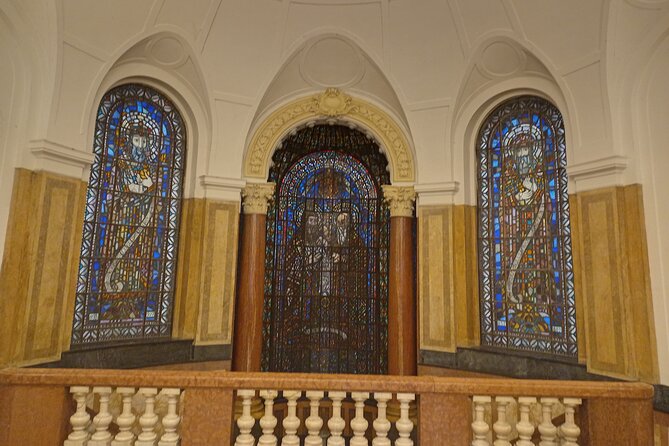
Peter’s Tours keeps the group to a maximum of 10 people. That is a meaningful limit on a walking tour. You are less likely to lose the guide in a crowded square, and there is more room to ask questions.
Peter has been praised for his patience, energy, and willingness to explain Bulgarian history. He has also been known to add bonus locations, answer questions on a wide range of Bulgarian topics, provide water, and wait while someone buys souvenirs. Those details suggest a flexible, personal style rather than a rigid script.
The English-language format is useful for first-time visitors who want context quickly. You can ask about architecture, religion, history, or the city’s modern life as the route unfolds.
The tour includes travel time between stops, so the total duration is not three hours of nonstop commentary. That is a good thing for most people. Sofia can be tiring in strong sun, and the short transport ride breaks up the walking. Wear comfortable shoes, carry water, and use sunscreen as advised.
Who should book this experience?
I would choose this tour if you have limited time in Sofia and want a strong first orientation. It suits you especially well if you like history but do not want to spend the day inside museums.
It also works for repeat visitors. One participant who had been to Sofia several times still learned new facts and appreciated entering the university and library. That is a useful sign that the route offers more than the standard cathedral photo stops.
Families and couples may appreciate the small group and short visits. The walk is also a good fit for solo visitors who want a guide and a little local direction without joining a large coach group.
You should think twice if you want a slow museum tour, extensive cathedral interiors, or a long food stop. The market is part of the route, but this is not a food tour. The walk covers a lot of ground, and most places receive only a short explanation.
The tour accepts most participants, is near public transportation, and provides a mobile ticket. Free cancellation is available up to 24 hours before the start time. At $45.66, the cost makes the most sense when you value the guide and the carefully linked route rather than admission tickets.
Should you book the Sofia walk?
Book it if you want to understand how Roman, Orthodox, Ottoman, Jewish, socialist, and modern Sofia fit together in one compact outing. The best parts are the Roman remains, the brief tram or metro ride, and the unusual opportunity to enter the National Library and Sofia University.
Skip it if your priority is independent wandering or long visits at individual sights. For most first visits, though, this is a practical introduction with a personal guide, a manageable group, and enough unusual stops to keep central Sofia from feeling predictable.
FAQ
How long does the Sofia Hidden Gems walking tour last?
The tour lasts approximately two to three hours, including walking and the travel time between stops.
What language is the tour offered in?
The tour is offered in English and includes an English-speaking guide.
How large is the group?
The tour has a maximum of 10 participants.
Is transportation included?
Yes. The tour includes a city transport card and a short tram or metro ride.
Where does the tour start?
The meeting point is Saint Sofia Church at ul. Paris 2 in Sofia’s Old City Center.
Where does the tour end?
The tour ends at Sofia Central Market Hall, on the lower level of the Central Sofia Market Hall at bul. Knyaginya Maria Luiza 25. The area is close to a bus station and other public transportation.
Can I cancel for a full refund?
Yes. You can cancel up to 24 hours before the experience start time for a full refund. Changes or cancellations made less than 24 hours before the start time are not accepted for a refund.
Just added around Bulgaria
- Seven Rila Lakes Snowshoe Hike and Thermal Baths Full-Day Tour from Sofia★ 4.5 · 43 reviews
- Seven Rila lakes-Snowshoeing with Waterfall and Hot Mineral pools★ 5.0 · 21 reviews
- Rila Monastery and Hot Mineral Bath Spa Complex Tour★ 4.5 · 27 reviews
- Boyana Church and Thermal SPA near Pancharevo Lake★ 5.0 · 2 reviews
- Borovets: Hot Mineral Springs★ 5.0 · 18 reviews
- Bansko: Villa Victoria Thermal pool escape★ 3.5 · 12 reviews
- Resilovo Monastery,Waterfall &Hot Springs DayTrip from Sofia★ 5.0 · 6 reviews
- Half Day Tour – Sofia and the mountains with Thermal Spa★ 5.0 · 5 reviews
Walking Tours, compared.
Kinabalu Park & Poring Hot Spring & Canopy Walk
Read our review →
Arenal Hanging Bridges, Guided Walk, Hot Springs Optional
Read our review →
Karlovy Vary: Mineral Hot Springs Tasting and Walking Tour
Read our review →
Arenal Volcano Expeditions Walk with Optional Hot Springs
Read our review →Browse the lists this tour appears in