
REVIEW · ISTANBUL
3 Days Ephesus, Pamukkale, Priene, Miletus and Didyma Tour from Istanbul
The best thing about this trip is the range. In three busy days, you move from Ephesus and its marble streets to quiet Priene, huge Didyma, and the white terraces of Pamukkale. You get far more than a standard Ephesus day trip, including sites many visitors skip.
I especially like the downhill route through Ephesus and the chance to see Priene, Miletus, and Didyma with a guide. I also like the practical setup: airport transfers, two hotel nights, site admissions, and a small group capped at 15 people. The drawback is the pace. Long drives, early departures, and several hours on your feet make this a better fit for active sightseers than relaxed holidaymakers.
Key points to know
- Six major ancient sites in three days: Ephesus, Priene, Miletus, Didyma, Hierapolis, and the Temple of Artemis all fit into one route.
- Ephesus is approached from the Upper Gate: You walk downhill through the ruins instead of starting with a tiring uphill climb.
- Priene and Miletus add quieter history: These sites offer a calmer counterpoint to busy Ephesus.
- Pamukkale combines ruins and thermal water: You visit Hierapolis, the museum, Cleopatra Pool, and the white terraces.
- The price excludes domestic flights: At $1,017.48 per person, compare the convenience against booking transport and hotels yourself.
- Guiding is a major part of the value: Güfte, Ogun, and Yavuz are named in the tour’s past experiences, with strong praise for their history knowledge, flexibility, and organization.
Why this three-day route works
This tour links the main ancient sites of Turkey’s Aegean coast in a sensible geographic loop. You fly from Istanbul to Izmir, base yourself in Kuşadası for two nights, then return to Istanbul from Denizli after Pamukkale.
That arrangement saves you from changing hotels every night. It also lets you see more than Ephesus alone. Ephesus is the headline attraction, but Priene, Miletus, and Didyma give you a better feel for ancient Ionia, while Hierapolis shows how Roman life met the natural hot springs at Pamukkale.
The schedule is full, but not random. Day one focuses on Ephesus and nearby Selçuk. Day two heads south toward Priene, Miletus, and Didyma. Day three crosses the Meander Valley to Pamukkale before your flight home.
The listed maximum is 15 people. Some previous arrangements have also been private or adjusted to suit the group, so ask about your exact format before paying for flights. The operator can advise you on flight times, which matters because the tour schedule depends on those tickets.
More Pamukkale and Hierapolis Tours from Istanbul:
- 4 Days Turkey Tour – Cappadocia, Ephesus and Pamukkale Tour
★ 5.0 · 138 reviews - 6 Days Turkey Tour Cappadocia, Pamukkale, Ephesus, Gallipoli Troy
★ 5.0 · 109 reviews - 7 Days Best of Turkey Tour: Istanbul-Cappadocia-Ephesus-Pamukkale
★ 5.0 · 91 reviews
Day one: from Istanbul to Ephesus
Your first morning begins with a private hotel transfer to Istanbul Airport. Pickup is scheduled at least three hours before your flight, so this is not a late-start holiday morning. You fly to Izmir, meet a driver outside the terminal, and travel about an hour to Selçuk.
That airport handoff is one of the tour’s useful features. You do not need to negotiate a taxi, find a bus, or work out how to connect Izmir Airport with the ruins. Look for the driver holding a sign with your name, then meet your guide and group in Selçuk.
The House of the Virgin Mary
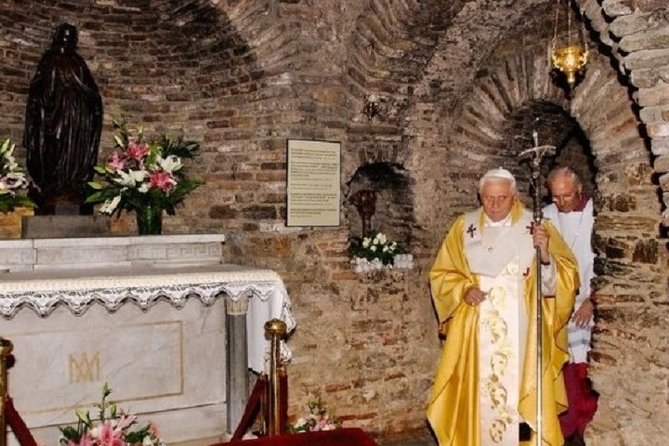
The first visit is to the small stone house on Mount Koressos traditionally identified as the final home of Mary. The setting is quiet, and the visit has a clear religious importance for many people.
You get about 45 minutes here. There is time to light a candle, leave a note on the Wishing Wall, and take in the peaceful setting before the larger historical sites begin. The house itself is modest, so do not expect a long museum visit. Its value comes from the atmosphere and tradition surrounding the place.
Walking downhill through Ephesus
Ephesus is the centerpiece of the tour, and the route begins at the Upper Gate. That is a smart choice. You walk downhill along ancient marble streets, with the major monuments opening up as you go.
Allow three hours for the ancient city. You will see the Celsus Library, the Temple of Hadrian, and the Great Theatre, where Paul preached. The scale is impressive, but the guide is what turns scattered stones into a city. Ask about daily life, public buildings, and the way the streets connected the city.
This is a long outdoor visit. Expect sun, uneven paving, and plenty of standing. Comfortable shoes, water, and a hat will make a real difference. The downhill route helps, but Ephesus is still a substantial walk.
A few more hot spring trips around Istanbul worth a look
- Explore Mount Rinjani To Summit, Lake & Hot Spring (3D 2N)
★ 5.0 · 19 reviews - Mount Rinjani 3D2N Private Trek – Summit, Crater Rim & Hot Spring
★ 5.0 · 13 reviews - 2 Nights and 3 Days of Lava and Hot Spring Tour in Danakil
★ 5.0 · 2 reviews
The Terrace Houses cost extra
The Terrace Houses are among the most rewarding parts of Ephesus for anyone interested in private life. These covered villas belonged to wealthy residents, and glass walkways let you look down at mosaics, frescoes, and ancient heating systems.
The visit takes about 45 minutes and includes steps inside the structure. Admission is not part of the main package, so budget for it separately. I would consider it worthwhile if you want more than grand monuments. The library and theater show public Ephesus. The Terrace Houses show how the elite lived behind closed doors.
A modern view of an ancient city
The Ephesus Experience Museum uses large screens, 3D sound, and sensory effects to recreate the city in its Roman period. You spend around 30 minutes here.
Some history-minded visitors prefer standing among the actual ruins, but this type of presentation can help you picture missing buildings, temples, and crowded streets. It works best after the archaeological visit, when you already know the layout. Admission is included.
Selçuk lunch and the Temple of Artemis
Lunch in Selçuk is not included, and the meal stop gives you a chance to try meze, hot dishes, and local desserts. Since drinks and personal expenses are also extra, keep some Turkish lira or a card available.
The final stop is the Temple of Artemis, once one of the Seven Wonders of the Ancient World. Only one column remains, but the site is useful because it puts several layers of Selçuk in one view: the ancient pagan sanctuary, Isa Bey Mosque, and the Basilica of St. John.
You then drive to Kuşadası for a four-star hotel. The evening is free for a walk along the promenade or dinner by the Aegean Sea. After a long day, that unplanned time is welcome.
Day two: Priene, Miletus, and Didyma
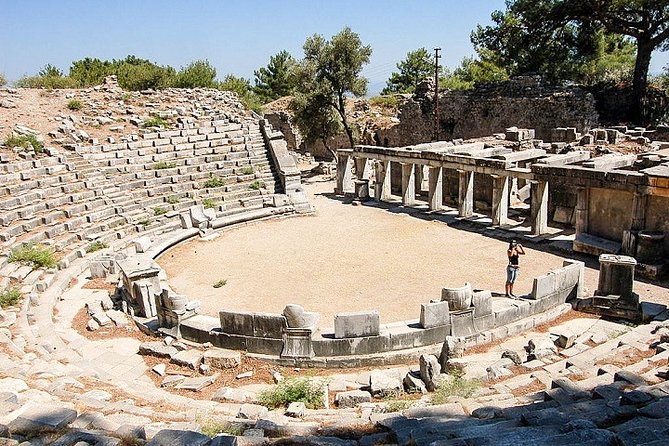
Day two is the most unusual part of the route. Many visitors stop at Ephesus and Pamukkale, but Priene, Miletus, and Didyma show a different side of western Turkey. The sites are spread out, so you spend time in the vehicle, but the driving connects three important places in one day.
Priene and the Meander Plain
Priene sits against Mount Mycale, surrounded by pine trees. It feels quieter than Ephesus and has a strong sense of place, with ancient streets climbing across the slope and views over the Meander Plain.
You spend about 90 minutes here. See the Bouleuterion, or council house, and the Temple of Athena, linked to Alexander the Great. The site’s original grid plan helps you understand ancient city planning.
Priene involves uneven ground and some uphill walking. The reward is space and silence, plus a broad view that makes the setting easy to understand. If you want a slower archaeological stop, this is probably your favorite morning visit.
Miletus and the great theater
Miletus was a major maritime city and the home of Thales, often associated with the beginnings of Western philosophy. The huge theater is the main visual feature, rising above the flat plain like a stone wall.
You also see the Baths of Faustina. Miletus has a different character from Priene. Priene is compact and set on a slope, while Miletus spreads across open ground and makes you think about trade, ports, and political power.
The site also has a connection to the New Testament. Paul gave his farewell speech to the elders of Ephesus here, according to Acts 20. If biblical history interests you, tell your guide. Guides such as Yavuz have been praised for using detailed explanations, anecdotes, and humor to bring these places to life.
Lunch in Didim
You stop in Didim for lunch before visiting the Temple of Apollo. Seafood is a natural choice in this coastal area, though Turkish staples such as pide and kebab are also available.
Lunch is not included, so the cost depends on what you order. This is also a good place to rest because the afternoon visit requires more walking over exposed ancient ground.
The enormous Temple of Apollo
Didyma was a sacred oracle center rather than a normal city. The Temple of Apollo was built on a huge scale, and its remaining columns make you feel small in a way that photographs cannot quite capture.
You will see the approach to the inner sanctuary, walk through dark passages, and look for the famous Medusa head. Allow about an hour. This is the strongest architectural stop of the day, while Priene offers the best setting and Miletus the strongest connection to civic life and philosophy.
The drive back to Kuşadası passes cotton fields and olive groves. You return in the late afternoon, with time to rest at the hotel. That second night in the same accommodation is a small but important comfort.
Day three: the road to Pamukkale
The drive from Kuşadası to Pamukkale takes about two and a half to three hours. You pass through the Meander Valley, with cotton fields, fig orchards, and Turkish villages along the way.
This is a long transfer, but it also explains why the tour is efficient. You are crossing a productive part of western Turkey rather than taking a short flight and losing the connection between the inland ruins and the coast.
Hierapolis, city of the dead
Hierapolis is known as the Holy City and sits above the Pamukkale terraces. The visit starts with the enormous necropolis, one of the largest ancient cemeteries in Anatolia.
You then see the Frontinus Gate and the theater, which offers views toward the white terraces. Allow two hours. The site is broad, so you need steady walking and protection from the sun.
Hierapolis is valuable because it is not simply an add-on to Pamukkale. Its streets, tombs, gates, and theater show how a Roman city developed around hot springs. The ruins also give the white terraces a historical setting.
The Hierapolis Archaeology Museum
The museum occupies restored Roman baths and takes about 30 minutes. Inside are sarcophagi, statues, and friezes from Hierapolis and nearby Laodicea.
The Hall of Statues includes mythological figures and gladiator reliefs. This stop is a good break from the open-air ruins and helps you notice the quality of the sculpture that once filled these cities. Admission is included.
Cleopatra Pool and the white terraces
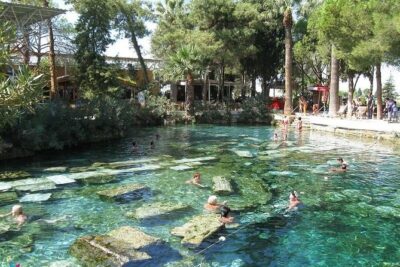
The Cleopatra Pool is optional. The entrance to the pool area is free, but swimming requires an additional ticket. The warm water contains submerged ancient marble columns, said to have fallen into the pool during an earthquake.
You get about 45 minutes here. If you plan to swim, bring what you need and allow for the extra cost. If you would rather save your energy, you can skip the swim and spend more time at Pamukkale itself.
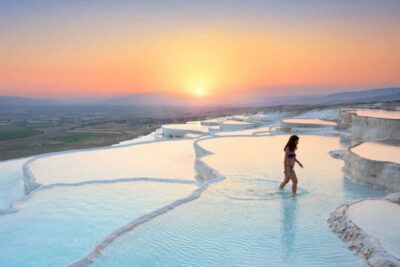
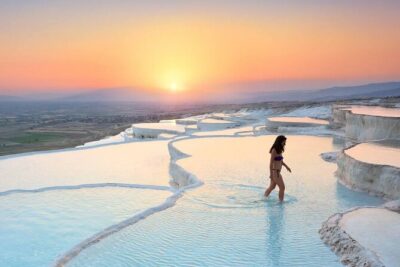
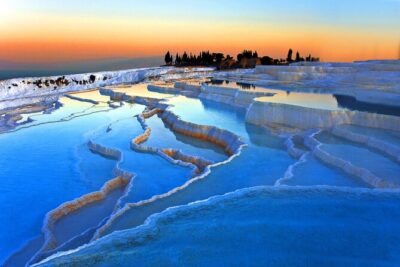
The terraces are the natural finale. Pamukkale means Cotton Castle, a fitting name for the white calcium deposits formed by thermal springs. You remove your shoes and walk barefoot over the terraces, where warm water runs across the pale stone.
This is not a normal swimming pool, and the usable areas can be limited. Follow your guide’s directions and protect your feet from the rougher sections. The visit lasts about 45 minutes, which is enough for photos and a close look, though you may wish it were longer.
Lunch follows in Pamukkale town. It is not included, but it gives you a chance to sit down before the final airport transfer.
What the $1,017.48 price really covers
The cost is high at first glance, especially because domestic flights are excluded. You also pay separately for lunches, dinners, drinks, tips, the Ephesus Terrace Houses, and swimming at Cleopatra Pool.
Still, the package includes two hotel nights, site and museum admissions listed in the schedule, air-conditioned transfers, airport pickups, and a professional guide. You are paying for a coordinated route through a wide part of western Turkey, not just for entry tickets.
The value improves if you dislike arranging separate flights, drivers, hotels, and archaeological guides. It is less attractive if you are comfortable using buses, booking your own rooms, and setting your own pace.
Ask for the exact hotel names, flight recommendations, and group format before booking. The package says four-star accommodation in Kuşadası, but the specific properties are not given.
The guide can shape the whole experience
The strongest part of this trip is the human side. Güfte is named in several experiences, along with her husband Ogun, and Yavuz is specifically associated with the Priene, Miletus, and Didyma route.
Güfte has been praised for adjusting the schedule to personal interests, adding local touches, and explaining the region with warmth. One past experience included tea at her home, which shows the kind of personal contact that can make a guided trip feel less mechanical. Yavuz is noted for anecdotes, historical detail, humor, punctuality, and Spanish ability.
That does not guarantee which guide you will receive. Ask before booking if a particular guide, language, or private arrangement matters to you.
The operator has also been praised for advance communication, reliable transfers, and professional timing. Those details matter here because a missed pickup or badly timed flight could damage the whole three-day plan.
Who should book this trip
I would choose this tour if you want to see the major archaeological sites of western Turkey but do not want to manage the transport yourself. It suits first-time visitors, history fans, and people who want both famous sites and quieter stops.
It is also a good match if you value explanation. Ephesus, Priene, Miletus, Didyma, and Hierapolis are easier to appreciate when someone connects the buildings to religion, trade, philosophy, and daily life.
I would hesitate if you need lots of free time, dislike long drives, or have difficulty walking on uneven ground. The schedule is demanding, and the Pamukkale day includes a long transfer before and after several outdoor visits.
The tour requires moderate physical fitness. Service animals are allowed, and the route is near public transportation in some areas, but the organized transfers are the practical choice.
Should you book it?
Book it if you want a tightly organized introduction to western Turkey and value a guide more than absolute flexibility. The combination of Ephesus, the three Ionian sites, and Pamukkale is difficult to arrange as neatly on your own in only three days.
Before committing, price the domestic flights and optional admissions separately. Then ask whether you will travel privately or in a group of up to 15, and confirm the hotel and flight times.
For an active visitor, the route offers excellent coverage and strong historical variety. For a slow traveler, it may feel like too much of Turkey in too little time. The free cancellation policy allows cancellation up to 24 hours before the start for a full refund, subject to the stated weather and minimum-group conditions, so you have some protection while finalizing plans.
FAQ
Are domestic flights included in the tour price?
No. Domestic flight tickets are not included. Contact the operator before buying flights so the departure and return times fit the schedule.
Where does the tour begin?
The tour begins with a private transfer from your Istanbul hotel to the airport. You then fly to Izmir, where a driver meets you outside the terminal.
Where do you stay during the tour?
You stay in local hotels, with two nights in a four-star hotel in Kuşadası.
Is lunch included?
No. Lunch, dinner, drinks, tips, and personal expenses are not included.
Is entry to the Ephesus Terrace Houses included?
No. The Terrace Houses require a separate admission fee. The main Ephesus entry is included.
Can you swim in Cleopatra Pool?
Yes, but swimming requires an extra ticket. Entry to the pool area itself is free.
How large is the group?
The tour has a maximum of 15 participants. Some arrangements may be private or adjusted, so confirm the format before booking.
What happens if you need to cancel?
You can receive a full refund if you cancel at least 24 hours before the experience begins. Changes or cancellations made later are not accepted for a refund under the stated policy.
Just added around Istanbul
- From Istanbul: Cappadocia Konya Pamukkale Ephesus 7 Nights★ 4.5 · 8 reviews
- Private Tour of Turkey In 7-Days: Cappadocia- Ephesus- Pamukkale- Istanbul★ 5.0 · 8 reviews
- 7 Day Istanbul-Cappadocia-Ephesus-Pamukkale Tour (Balloon Ride)★ 5.0 · 5 reviews
- Yalova Thermal Hot Springs Day Trip from Istanbul★ 3.5 · 3 reviews
- Turkey’s Wonders – Pamukkale, Ephesus, Cappadocia Travel from-to Istanbul★ 4.5 · 18 reviews
- Turkey’s Highlights – Pamukkale, Ephesus, Cappadocia Trip & Balloon Ride Option★ 4.0 · 19 reviews
- Private Pamukkale Day Tour from Istanbul by Plane★ 5.0 · 13 reviews
- 5 days Private Tour of Western Turkey (Troy-Pergamon-Ephesus-Didyma-Pamukkale)★ 5.0 · 3 reviews
Pamukkale & Hierapolis Tours, compared.
Pamukkale Hierapolis and Cleopatra’s Pool Tour with lunch from Antalya
Read our review →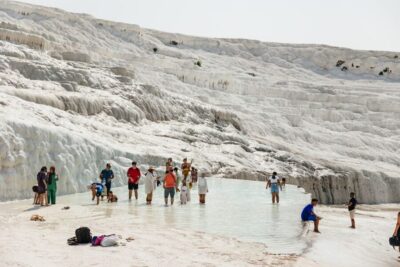
Antalya Pamukkale Hot Springs & Hierapolis Tour With Lunch
Read our review →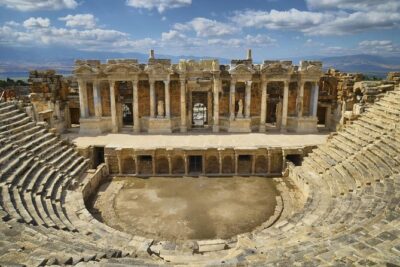

Full-Day Tour of Pamukkale from Antalya with Lunch
Read our review →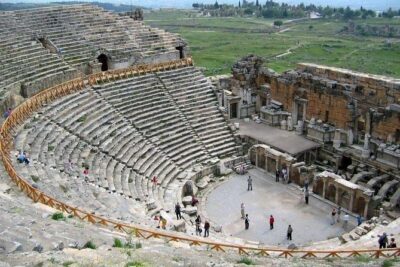
Full-Day Tour to Pamukkale From Marmaris w/ Breakfast & Lunch
Read our review →Browse the lists this tour appears in