
REVIEW · ISTANBUL
4 days Turkey highlight: Pamukkale Ephesus and Cappadocia
Pamukkale’s white terraces, Ephesus’s marble streets, and Cappadocia’s strange volcanic rock formations make this one fast, far-reaching Turkey itinerary. In four days, you move from thermal springs and Roman ruins to underground cities and fairy chimneys, with flights and transfers arranged for you.
I like the practical package: round-trip flights, airport transfers, meals, entrance fees, and a hotel night are included. I also like the mix of big sights and smaller stops, from the Temple of Artemis and the Virgin Mary’s House to pottery-making town Avanos and the sunset colors of Red Valley.
The trade-off is pace. This is not a slow countryside holiday. You cover large distances, start early, and spend long stretches touring ancient sites and Cappadocian valleys. The $1,500 price can be fair for the amount included, but you should confirm the exact flight schedule, hotel details, and day-by-day arrangements before paying.
Key points to know before booking
- Pamukkale combines bathing and archaeology: You get time at the thermal terraces, Cleopatra’s Pool, Hierapolis, and its large Roman theater.
- Ephesus is the history centerpiece: Allow three hours for one of Turkey’s best-preserved ancient cities, then visit nearby religious and Ottoman sites.
- Cappadocia gets two full touring days: The program covers Uçhisar, Red Valley, Çavuşin, Göreme, Avanos, Devrent Valley, Paşabağ, and more.
- The group is capped at 15 people: That is small enough for a more personal guided outing, though the exact guide names are not provided.
- Most major costs are bundled: Flights, four lunches, three breakfasts, transportation, admission fees, and one night in Kusadasi are included.
- Plan for your own dinners: Dinner is not included, and the packed schedule leaves little room for spontaneous restaurant hunting.
Why this four-day route works, and where it feels rushed
This trip links three very different parts of Turkey. Pamukkale is about mineral terraces and Roman spa culture. Ephesus brings you into the ancient Mediterranean world. Cappadocia shifts the mood again, with soft volcanic rock carved into churches, homes, and entire underground settlements.
I like that the route does not rely on one type of attraction. You are not spending four days looking at ruins or four days taking photographs from viewpoints. You get natural sights, archaeology, religious history, traditional craft, villages, and short walks.
The main issue is time. The listed stops add up to long touring days, especially in Cappadocia. You will see many places, but you will not have unlimited time at any one of them. If you prefer lingering over lunch, taking long walks, or exploring a museum room by room, this schedule may feel tight.
The package is designed for convenience. Pickup is available from hotels and apartment hotels, and airport transfers are included. With flights, transportation, admission fees, lunches, breakfasts, and one Kusadasi hotel night covered, you avoid much of the planning work that usually makes a multi-region trip difficult.
Still, ask for the final operating details. The information gives a four-day program, but it does not identify the exact domestic flight times, the hotel name, or the guide assigned to each day. Those details matter because they affect how much free time you actually have.
More Pamukkale and Hierapolis Tours from Istanbul:
- 4 Days Turkey Tour – Cappadocia, Ephesus and Pamukkale Tour
★ 5.0 · 138 reviews - 6 Days Turkey Tour Cappadocia, Pamukkale, Ephesus, Gallipoli Troy
★ 5.0 · 109 reviews - 7 Days Best of Turkey Tour: Istanbul-Cappadocia-Ephesus-Pamukkale
★ 5.0 · 91 reviews
Day 1: Pamukkale’s white terraces and Hierapolis
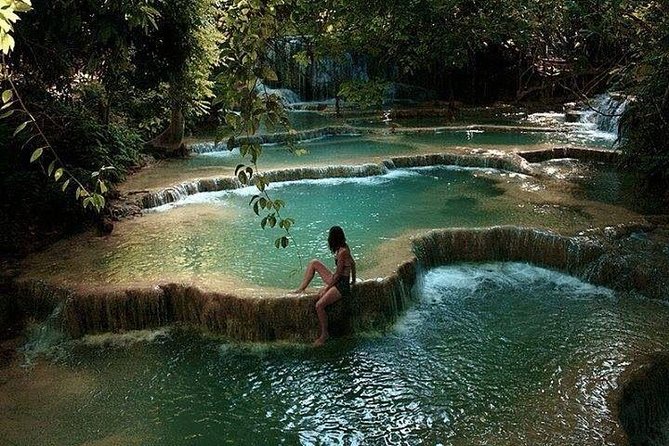
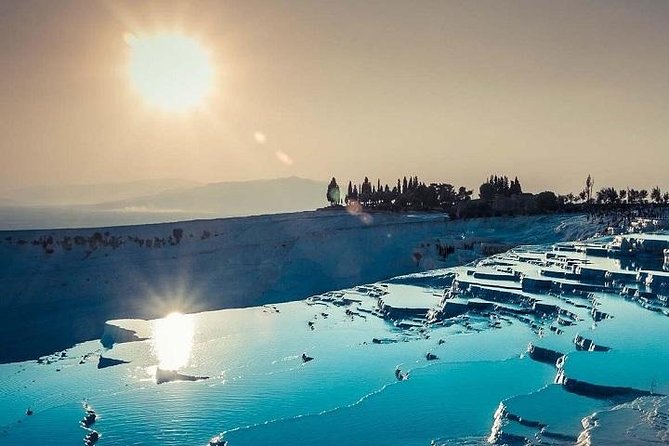
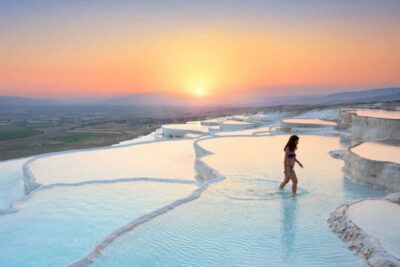
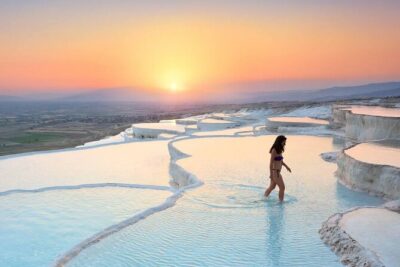
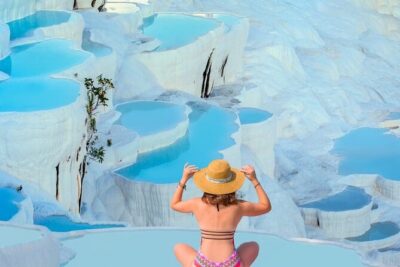
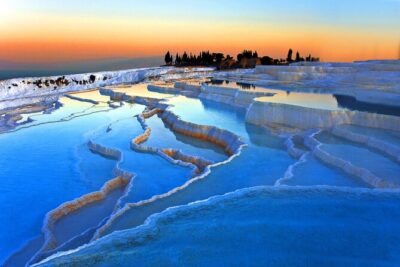
Pamukkale translates as Cotton Castle, a fitting name for the bright mineral terraces that spill down the hillside. Hot spring water has deposited calcium-rich minerals over many years, creating the famous white formations.
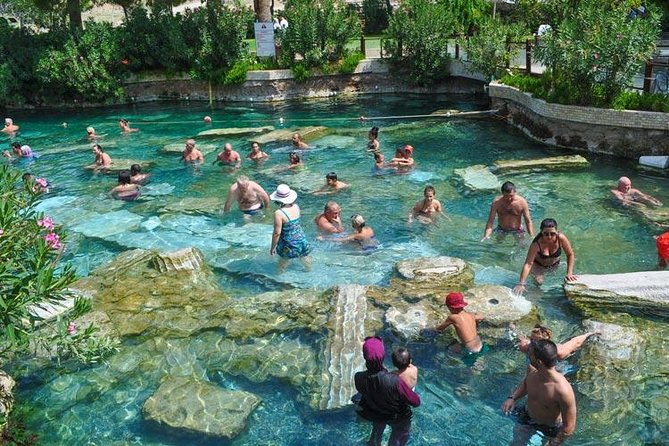
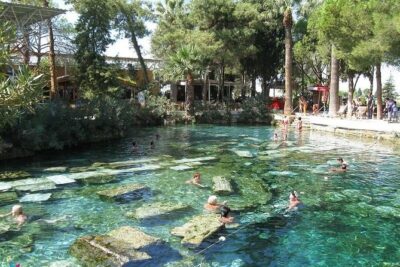
You have about two hours at the Pamukkale thermal pools. This is the day’s most unusual stop, and the schedule allows enough time to see the terraces rather than treating them as a quick photo stop. The tour also includes time for a relaxing swim in the thermal springs and Cleopatra’s Pool.
Bring practical footwear and clothing that can handle wet conditions. The white surface can be slippery, and the combination of sun, water, and pale stone can feel intense. The supplied information does not specify changing-room arrangements, so ask what is available before you arrive if swimming is important to you.
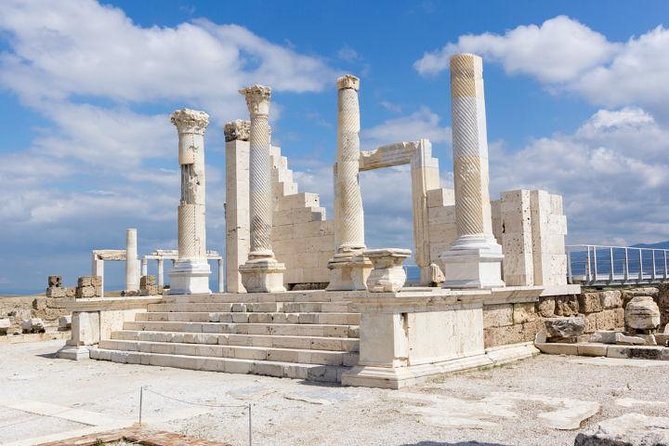
The nearby ancient city of Hierapolis adds depth to the visit. Founded as far back as the second century, it grew as a spa city where people came to seek relief from illness and aching joints. Over time, Pagan, Roman, Jewish, and Christian influences shaped the city.
You get about two hours among the ruins. That is useful because Hierapolis is more than a backdrop for Pamukkale photographs. Its remains show how a healing center developed into a major ancient settlement.
The Hierapolis theater gets another 30 minutes. It once held as many as 15,000 people, and you can still see the steep aisles and passages leading toward the stage. The scale helps you picture the city as a working public center rather than a scattered collection of stones.
The final stop is described as the Byzantine Church and Gymnasium, with about 30 minutes included. In Roman times, a gymnasium served as a place for exercise, training, social life, and public display. This short visit gives you another look at everyday life in the city.
Day 1 is strong for anyone who likes a clear combination of nature and archaeology. The drawback is that the terraces can be crowded and exposed, and the walking surfaces are not always easy. You will get the best value from the day if you treat the thermal pools and ruins as two connected parts of one ancient spa complex.
Day 2: Ephesus, Mary’s House, and Selçuk’s smaller treasures
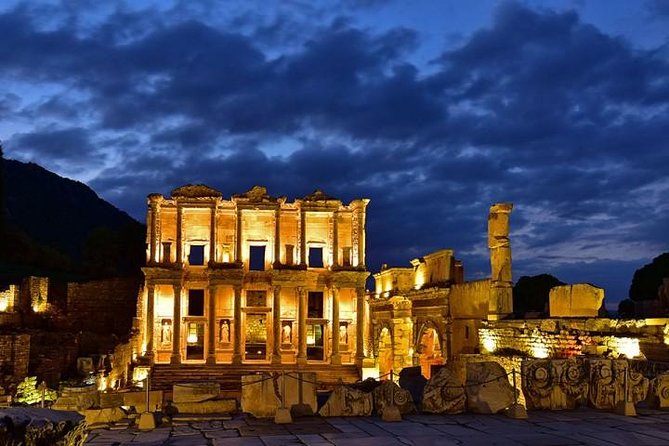
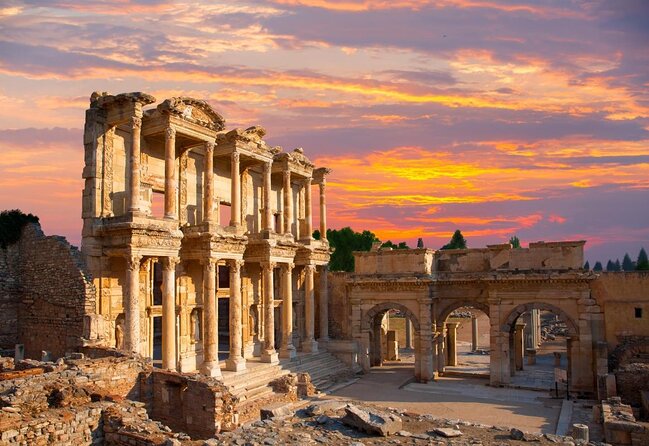
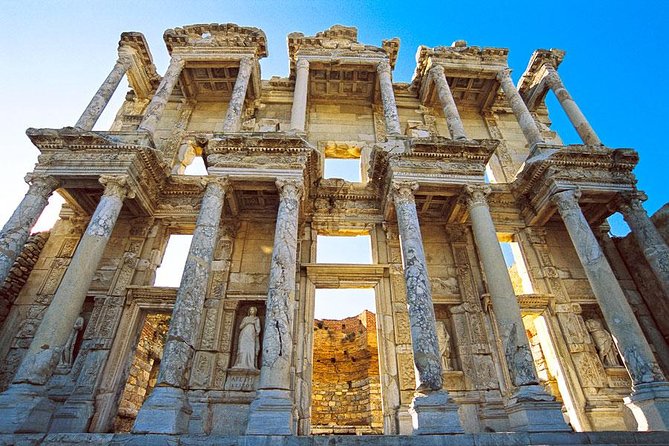
Ephesus is the major archaeological event of the second day. Once home to more than 200,000 people, it is known for its well-preserved streets, monumental buildings, and strong sense of scale.
The tour gives you three hours at the ancient city. That is the right amount of time for a guided overview of the main areas, though anyone fascinated by archaeology may wish for longer. Wear comfortable shoes, since the visit involves walking over historic surfaces and open ground.
Ephesus matters because it lets you see how a major ancient city functioned. You are not simply looking at one isolated temple. The remains form a broad urban setting, and the guide’s explanations are an important part of making sense of the monuments.
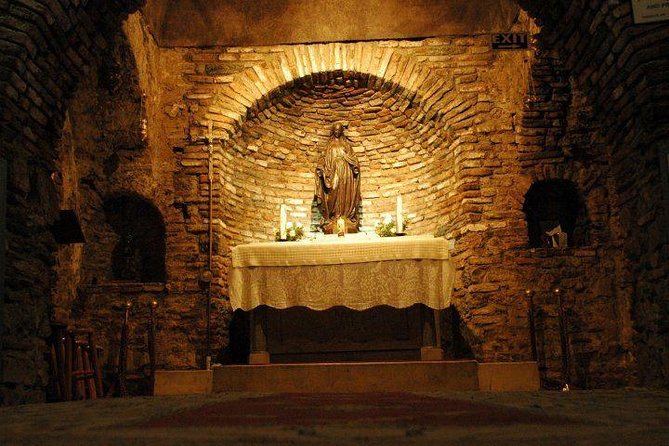
Next comes Meryemana, or the House of the Virgin Mary, on Bülbül Mountain above Selçuk. The site is regarded as the place where Mary spent the later years of her life and is an important Christian pilgrimage destination.
You get one hour there. This stop will appeal most if you are interested in religious history or pilgrimage sites. Even if you are not religious, the hilltop setting and connection with Ephesus give the visit a different tone from the ancient city below.
The Temple of Artemis takes about 30 minutes and has no separate admission charge in the supplied tour details. It was one of the Seven Wonders of the ancient world and dates back as far as the sixth century BC. Today, only foundations and a few columns indicate its former size.
This is a quick stop, so keep your expectations in check. You are not visiting a complete temple. You are seeing the remains of a monument whose importance comes partly from what once stood there.
The Isa Bey Mosque follows, also for about 30 minutes. Built in 1374 and 1375, it is known for Seljuk architectural details, crown-like entrances, and decorative mosaics. The mosque gives the day a useful change of period, moving from ancient Greek and Roman history into medieval Anatolia.
I like this day because it avoids making Ephesus the entire story. You see ancient urban life, a Christian pilgrimage place, one of the ancient world’s celebrated monuments, and Seljuk architecture within a compact area.
Your overnight stay is in Kusadasi, with breakfast included and a location described as being by the sea. A seaside setting can make a welcome end to a long sightseeing day. Dinner is not included, so budget separately for that evening.
Day 3: Cappadocia from Uçhisar to Derinkuyu
Day 3 shifts to Cappadocia and packs in six stops. Uçhisar Castle is a natural rock formation carved into volcanic stone and located at one of the area’s highest points.
You have one hour to explore the tunnels, rooms, and old dwellings while taking in wide views over the surrounding valleys and fairy chimneys. The castle is valuable both as a viewpoint and as a reminder that Cappadocia’s rocks were used for shelter and defense, not only admired for their shapes.
Kızılçukur Valley, also called Red Valley, gets two hours. Its red and pink rock formations are especially striking around sunset, and the route includes a walk through fairy chimneys, rock-cut churches, vineyards, and quiet paths.
This is one of the more active portions of the tour. The description calls for a two-hour walk, so bring suitable shoes and be ready for uneven ground. You may find the sunset timing especially appealing, but the exact light depends on the season and the day’s schedule.
Çavuşin village offers another view of Cappadocia. Its rock-carved houses and churches include the Church of St. John the Baptist, dated to the fifth century and known for frescoes. You get about an hour here.
I like Çavuşin because it connects the famous rock formations with lived-in village history. It is more personal in scale than a large viewpoint, though the one-hour visit means you will need to choose between looking around, taking photographs, and following the guide’s explanation.
Love Valley follows with a 30-minute stop. The tall, unusual rock pillars were shaped by erosion and are now among Cappadocia’s most photographed formations. The name is easy to understand when you see the shapes.
The short visit makes this mainly a viewpoint and photo stop rather than a full hike. That is sensible after the longer Red Valley walk, but you should not expect to explore the valley trails in depth.
Derinkuyu Underground City is the day’s most surprising stop. Built around the eighth or seventh century BC, it extends through multiple levels and includes living areas, kitchens, chapels, storage spaces, and ventilation systems. It could shelter as many as 20,000 people, along with animals and supplies.
The tour allows one hour. You will move through narrow passages and rooms, so this stop may feel more demanding than the open valleys. It is a strong choice for anyone curious about how people organized life underground during periods of war and invasion.
The final stop is Pigeon Valley, named for the pigeon houses carved into the rock. Local people once valued the birds’ droppings as farm fertilizer. You have 30 minutes to look over the valley, which connects the area around Göreme with Uçhisar.
Day 3 has the widest range of scenery, but also the greatest risk of feeling hurried. Six stops, a two-hour walk, and an underground city make comfortable shoes, water, and a willingness to keep moving essential.
A few more hot spring trips around Istanbul worth a look
- Private 4 Days Turkey Tour from Istanbul to Cappadocia, Ephesus, Pamukkale
★ 5.0 · 80 reviews - 4 Day Turkey Tour : Cappadocia, Ephesus and Pamukkale
★ 4.5 · 36 reviews - 4 Day Turkey Tour: Cappadocia, Ephesus, Pamukkale by Plane
★ 4.5 · 32 reviews - Cappadocia & Ephesus & Pamukkale 4Days 3Nights Tour by Plane
★ 5.0 · 30 reviews
Day 4: Rock-cut churches, pottery, and strange stone shapes
The final day begins at Göreme Panorama, a 30-minute viewpoint over Cappadocia’s fairy chimneys, valleys, and volcanic rock formations. Early light and sunset are especially attractive here, and hot-air balloons may be visible in the sky during the morning.
The viewpoint gives you a quick visual map of the region before the day’s closer visits. Since the stop is short, use it to take in the broad view rather than expecting a long walk.
Göreme Open-Air Museum is the historical center of Day 4. This UNESCO World Heritage Site contains rock-cut churches, chapels, monasteries, and living quarters, many decorated with frescoes from the 10th through 12th centuries.
The visit lasts about two hours and includes the main admission fee. The Apple Church, Snake Church, and Dark Church are among the named highlights. The painted interiors are often the reason people remember this stop, but you should also notice how the religious buildings were cut directly into the soft rock.
This is a place where a guide adds real value. Without context, the caves can look like a string of similar rooms. With explanations, you can better understand the monastic communities that used them and the purpose of the paintings.
Avanos comes next for one hour. This town sits along the Kızılırmak River and is known for pottery made from the river’s red clay. The tradition reaches back to the Hittite period.
You can visit workshops and watch artisans shape ceramics using old techniques. Some studios offer hands-on pottery, though the provided details do not promise that the activity is included, so ask before assuming you will make a piece yourself.
Devrent Valley, or Imagination Valley, gets two hours. Unlike Göreme Open-Air Museum, it has no churches or cave dwellings. Its appeal is purely natural: wind and water have shaped rocks that people compare to animals and objects, including a camel, dolphin, and human face.
This is a playful stop, best enjoyed with time to look around and decide what shapes you see. The two-hour allowance is generous compared with several other viewpoints, but the area is still about rock formations and photographs rather than a formal archaeological site.
Paşabağ, also called Monk’s Valley, is known for mushroom-shaped fairy chimneys. Some contain chapels and dwellings once used by monks seeking solitude and worship.
You get one hour here. It is a good place to examine the formations at close range, especially after seeing them from distant viewpoints. The stop also adds a religious layer to Cappadocia’s natural scenery.
The final stop is the Three Beauties near Ürgüp. The viewpoint looks over the town and nearby vineyards, wine production areas, and apricot gardens. With 30 minutes available, this is another short photo stop that finishes the trip on a broad scenic note.
What the $1,500 price really covers
At $1,500 per person, this is not a budget sightseeing day. The value comes from combining several expensive and time-consuming pieces: round-trip flights, airport transfers, two days of small-group touring, transportation, guides, entrance fees, four lunches, three breakfasts, and one night at a Kusadasi hotel.
That package can save you considerable planning time. You do not have to arrange separate transport between Istanbul, the Aegean coast, Pamukkale, and Cappadocia. You also avoid paying admission at each included site.
The value is less clear if you already have domestic flights, hotels, or a private car arranged. You are paying for convenience as well as sightseeing, so compare the package with the cost of booking those parts separately.
Dinner is excluded. You should also confirm whether the advertised one-night hotel is the only accommodation included and how the Cappadocia nights are handled, since the supplied details do not spell out the full hotel schedule. That question is important before booking.
Who will enjoy this tour most
I would choose this tour if you want Turkey’s biggest highlights but have only four days and prefer one company to handle the moving parts. It fits first-time visitors who want ancient sites, natural formations, religious places, and village stops in one compact package.
It also suits families and small groups who value hotel pickup and airport transfers. The maximum group size of 15 is modest, and the guided format can make complex sites such as Ephesus, Hierapolis, and Göreme easier to understand.
I would hesitate if you dislike early starts, long drives, uneven walking surfaces, or fixed schedules. People who want several quiet hours in one town, long meals, or extensive hiking should consider a slower trip.
The tour is offered in English, and confirmation is provided at booking. Most people can participate, and the experience is near public transportation, though the schedule itself relies heavily on arranged transfers.
Should you book the Pamukkale, Ephesus, and Cappadocia tour?
Book it if your priority is coverage. You will see Pamukkale’s thermal terraces, the ruins of Hierapolis and Ephesus, the Temple of Artemis, Cappadocia’s valleys, an underground city, rock-cut churches, and traditional pottery country in four days.
Do not book it expecting a restful pace. The program is ambitious, and the $1,500 cost makes the most sense when you value included flights, transfers, meals, entry fees, and guided transport.
Before committing, ask for the exact flight times, hotel name, daily pickup schedule, guide arrangements, and details about swimming at Cleopatra’s Pool. If those answers fit your schedule and you are ready for a busy route, this is an efficient way to see three of Turkey’s most memorable regions.
FAQ
How long is the tour?
The tour lasts approximately four days.
Where does the tour begin?
The experience is based in Istanbul, Turkey, with pickup offered from hotels and apartment hotels.
Is the tour offered in English?
Yes. The tour is offered in English.
What is the maximum group size?
The tour has a maximum of 15 participants.
Are flights included?
Yes. Round-trip flight tickets with all taxes are included.
Are airport transfers included?
Yes. Airport transfers are included, along with hotel pickup.
How many hotel nights are included?
The supplied details include one night at a Kusadasi hotel with breakfast and a seaside setting.
Are meals included?
Three breakfasts and four lunches are included. Dinner is not included.
Are entrance fees included?
The package includes entrance fees for the listed included attractions. The Temple of Artemis and Isa Bey Mosque are identified as free admission stops.
What is the cancellation policy?
You can receive a full refund if you cancel at least six full days before the experience begins. Cancellation two to six full days before the start may receive a 50 percent refund. Cancellations less than two full days before the start are not refunded. If poor weather cancels the tour, you are offered another date or a full refund.
Just added around Istanbul
- From Istanbul: Cappadocia Konya Pamukkale Ephesus 7 Nights★ 4.5 · 8 reviews
- Private Tour of Turkey In 7-Days: Cappadocia- Ephesus- Pamukkale- Istanbul★ 5.0 · 8 reviews
- 7 Day Istanbul-Cappadocia-Ephesus-Pamukkale Tour (Balloon Ride)★ 5.0 · 5 reviews
- Yalova Thermal Hot Springs Day Trip from Istanbul★ 3.5 · 3 reviews
- Turkey’s Wonders – Pamukkale, Ephesus, Cappadocia Travel from-to Istanbul★ 4.5 · 18 reviews
- Turkey’s Highlights – Pamukkale, Ephesus, Cappadocia Trip & Balloon Ride Option★ 4.0 · 19 reviews
- Private Pamukkale Day Tour from Istanbul by Plane★ 5.0 · 13 reviews
- 5 days Private Tour of Western Turkey (Troy-Pergamon-Ephesus-Didyma-Pamukkale)★ 5.0 · 3 reviews
Pamukkale & Hierapolis Tours, compared.
Pamukkale Hierapolis and Cleopatra’s Pool Tour with lunch from Antalya
Read our review →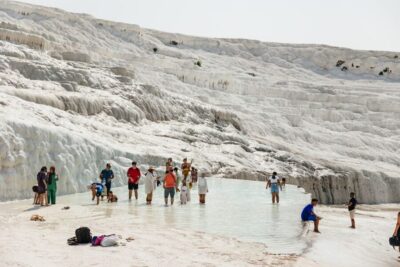
Antalya Pamukkale Hot Springs & Hierapolis Tour With Lunch
Read our review →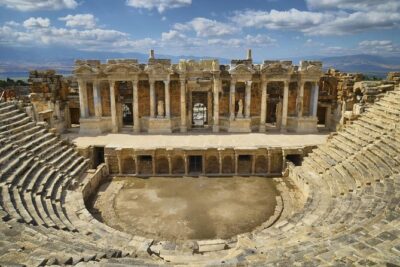
Full-Day Tour of Pamukkale from Antalya with Lunch
Read our review →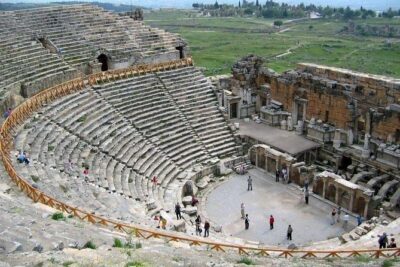
Full-Day Tour to Pamukkale From Marmaris w/ Breakfast & Lunch
Read our review →Browse the lists this tour appears in